
My heart was hammering against my ribs with such violence that I was terrified he could hear the frantic rhythm in the quiet kitchen.
“Thanks,” I managed to say, keeping my hands firmly at my sides. “But I already took my evening medication.”
“These are new. They are much more effective,” David countered smoothly. He unscrewed the child-proof cap and tapped two pristine, white pills into the center of his palm. “Take them right now, Dad. They’ll help you sleep better.”
“I would rather wait until tomorrow,” I stalled, my gaze locked on those tiny, lethal capsules. “I want to run it by my doctor first.”
The mask finally slipped. David’s expression shifted, the manufactured concern evaporating into thin air. I saw something staring back at me from his eyes that I had never witnessed in my entire life. It was a calculating, reptilian coldness that completely erased the son I knew.
“I insist, Dad. It is for your own good,” he said, his voice dropping to a dangerous whisper. He took a deliberate step toward me, holding out his open hand.
Just then, Amanda stepped out from the shadows of the dining alcove, filling the kitchen doorway.
“The police just arrived, Michael,” she announced. Her voice was a whip-crack of pure, unyielding authority.
David spun around, his eyes wide with sudden shock. His fingers instinctively curled inward, crushing the pills into the meat of his palm. “Police?” The terrifyingly calm facade shattered, his voice trembling with genuine panic. “Why did you call the police?”
Before I could formulate an answer, heavy boots sounded in the hallway. Two uniformed officers stepped into the cramped space of my kitchen, their hands resting cautiously on their duty belts. Directly behind them stood Captain Marcus Reed, dressed in a muted plainclothes suit.
“David Stafford?” Captain Reed asked, his tone professional and heavy with consequence.
My son swallowed hard and offered a rigid, jerky nod. He looked visibly terrified.
“We have a few serious questions regarding a digital timing device found wired into this house,” the captain continued, his eyes scanning the room. “We also need to discuss a vial of tightly controlled substances, and a multi-million-dollar life insurance policy that was quietly activated four months ago. I strongly suggest you come with us down to the station.”
David looked back at me. The icy predator was gone. His eyes were wide and brimming with absolute panic. For a fleeting, heartbreaking second, I didn’t see a grown man attempting murder; I saw the scared little boy I used to comfort after a terrible nightmare.
Then, just as quickly, the vulnerability vanished. His jaw set into a hard, defiant line.
“I don’t know what you are talking about,” David stated, his voice tight. “I just drove over to visit my father. I wanted to bring him some vitamins.”
Captain Reed gestured toward the small glass bottle sitting on the table. “Are those the vitamins in question? Do you mind if we take them down to the lab to have them chemically analyzed?”
In that exact moment, the invisible string holding David together simply snapped. He seemed to physically collapse in on himself. His broad shoulders slumped forward, and all the aggressive tension melted from his face, replaced by an expression of utterly hollow defeat.
“He ordered me to do it,” David murmured. The words were so faint I barely caught them over the hum of the refrigerator. “He said it was the only way.”
I stepped forward, my hands raised defensively. “Who ordered you, son?”
David slowly lifted his head. His eyes were completely vacant, staring through me into some terrifying middle distance. “The man in the corner,” he whispered. “The one who talks to me when no one else is around. He said if I didn’t do it tonight, he would come for me instead.”
A terrible, freezing chill raced down the entire length of my spine. I looked into the corners of my brightly lit kitchen. There was no man. There was no conspiracy. My son was talking about voices existing entirely inside his own head.
“David,” Captain Reed interjected, his voice surprisingly gentle for a seasoned detective. “How long have you been hearing this man?”
“For a while,” David answered, his hands coming up to grip the sides of his head as if he were trying to hold his skull together. “Months. Years, maybe. He wanted me to make sure Dad was absolutely alone every night, so that no one would interfere with the plan.”
I looked over at Amanda. Her dark eyes reflected the same devastating realization that was currently tearing my heart to shreds. This nightmare was entirely beyond financial ruin. It was beyond life insurance payouts and crippling debt. My son was not a cold-blooded monster. He was profoundly, gravely ill.
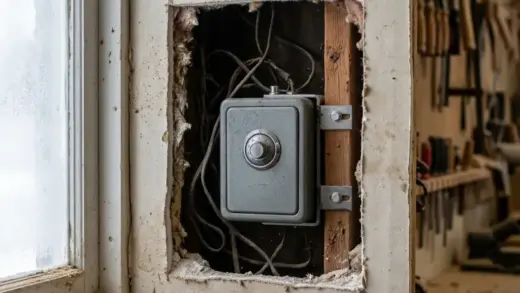
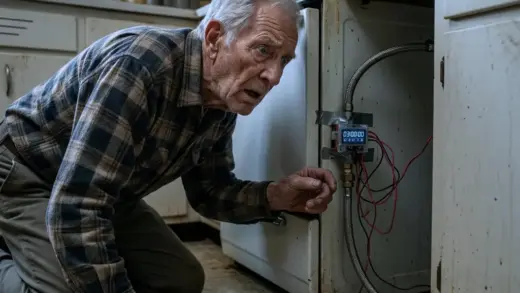
As the uniformed officers gently pulled David’s arms behind his back, securing the steel handcuffs around his wrists and reciting his Miranda rights, I felt my entire world quietly fall apart. The police confiscated the shattered pills and the vial, and upon searching his canvas backpack, they discovered three more rigged valves identical to the one Helen had found behind my stove.
“Mr. Stafford,” Captain Reed said softly as the officers led David out the back door. “We will need you to come down to the precinct for your formal statement tomorrow morning. In the meantime, I strongly advise you to request a full psychiatric hold and evaluation for your son.”
I could only nod, my throat locked tight around a sob. I followed them out to the porch, watching helplessly as they guided David into the back of a marked cruiser. His lost, wandering gaze through the reinforced glass absolutely broke me. How had I completely failed to notice he was suffering so deeply? How had I missed the agonizing signs of his mind fracturing?
“It is not your fault, Michael,” Amanda said softly, stepping up beside me on the porch as the cruiser’s taillights disappeared down the dark street. “Severe mental illness can be incredibly adept at hiding, even from the people who love the patient the most.”
When Amanda finally left, I found myself entirely alone in my silent living room, staring blankly at the dark screen of my cell phone. The nine-fifteen calls. His rigid insistence on knowing if I was by myself. The phantom footsteps in the dead of night. It all carried a darker, infinitely sadder meaning than the calculated greed I had initially assumed.
That night, for the first time in ninety days, my phone did not ring at nine-fifteen. Instead of the relief I had anticipated, a suffocating emptiness settled over the house. My boy was sitting in a holding cell, facing severe felony charges. And I had just learned that the imminent threat to my life did not originate from the son I had raised, but from a relentless disease that had hollowed him out and replaced him with a stranger.
Tomorrow would bring harsh interrogations. A mountain of legal paperwork. Defense lawyers and clinical doctors. But tonight, all I could focus on were the hundreds of times David had asked if I was alone. Perhaps, deep in the darkest corners of his fractured mind, he was the one who had always felt utterly, terrifyingly isolated. He was trapped in a brain that was playing lethal tricks on him, and I, the man supposed to protect him from the monsters, had failed to see the danger.
Sleep never came. How could I possibly rest, knowing my flesh and blood was locked behind iron bars, facing years in prison for attempting to end my life? Dawn eventually broke, finding me still seated in my worn armchair, my hands wrapped around a mug of coffee that had gone ice cold hours ago.
At exactly seven in the morning, a soft knock rattled my front door. It was Amanda. She had deep, bruised circles beneath her eyes, a clear sign she had not slept either.
“How are you holding up, Michael?” she asked gently as I let her inside, though the grim answer was etched into every line on my face.
“Destroyed,” I admitted, my voice rough as sandpaper. “I just keep replaying the last three years in my head. I should have noticed. I should have seen the cracks forming.”
“Do not torture yourself with hindsight,” she commanded, setting her briefcase on the coffee table. “The only thing that matters right now is getting David the medical intervention he desperately needs.”
She was right. Amanda was always right when it mattered most. It was the quality I appreciated above all else—her remarkable ability to maintain a perfectly clear, strategic head while the world was burning down around us.
“I spoke with Captain Reed an hour ago,” she continued, taking a seat on the edge of the sofa. “David spent the entire night secured in the medical wing of the precinct. They had an on-call psychiatrist run a preliminary evaluation.”
“And what did they say?” I leaned forward, desperate for a lifeline.
“The attending doctor believes David is currently suffering from a severe, acute psychotic episode,” she explained, her tone measured. “He documented paranoid schizophrenia as the preliminary clinical diagnosis. They will need to conduct extensive, long-term evaluations to confirm it.”
The word schizophrenia landed squarely on my shoulders with the crushing weight of a collapsing building. I had heard of the illness, of course, but always as a tragic abstract. It was something devastating that happened to other families, not to the Stafford men.
“What happens to him now?” I asked.
“There is an emergency preliminary hearing scheduled for ten o’clock this morning,” she replied. “The presiding judge will look at the medical evaluation and determine if David should be remanded to county custody, or if he can be safely transferred to a secure psychiatric institution while the criminal investigation remains active.”
“We have to be in that courtroom,” I said, pushing myself up from the armchair with renewed, desperate resolve.
“Absolutely,” Amanda agreed with a firm nod. “But before we head downtown, there is someone standing outside who urgently needs to speak with you.”
Before I could even process the statement, the doorbell chimed. Amanda walked over and pulled the heavy oak door open. Stepping into my foyer was a woman I had not laid eyes on in over two years. Jessica Anderson, David’s ex-wife.
“Michael,” she said softly, crossing the room to wrap her arms around me in a fierce, trembling hug. “I am so incredibly sorry.”
Jessica and David had been married for five seemingly solid years before finalizing their divorce two years ago. I had been told it was due to standard, irreconcilable differences. Believing it was entirely their private business, I had intentionally kept my distance, never prying into the painful details of their separation.
“Jessica, what are you doing all the way out here?” I asked, guiding her toward the sofa.
“Amanda called me late last night. She laid everything out for me,” Jessica explained, taking a seat. She nervously twisted a crumpled tissue between her fingers. “Michael, there are things you urgently need to know about your son. Terrifying things I promised I would never tell you.”
My pulse instantly accelerated. “What kind of things?”
“David started to dramatically change about three years ago, right before we officially separated,” she began, her eyes locked on the floor. “In the beginning, it was just small, easily excusable things. He would entirely forget major anniversaries. He would sit on the edge of the bed and stare blankly at the wall for twenty minutes straight. I would catch him whispering furiously under his breath when he thought I had left the room.”
“That doesn’t sound entirely abnormal for a man under heavy corporate stress,” I commented, though a familiar, sickening knot was already tightening in my gut.
“But then the paranoia took root,” Jessica said, her voice cracking. “He started actively accusing me of orchestrating conspiracies against him. He claimed I was secretly calling his firm to sabotage his projects. He insisted I was intentionally moving his keys and wallet just to make him question his own sanity. One night, I woke up at two in the morning to find him sitting in the pitch-black kitchen, holding a carving knife. He was absolutely convinced that a stranger had broken into our home to poison our food supply.”
Every single word she spoke felt like a physical blow to the chest. “How could he hide all of this from me? Why did you never pick up the phone and tell me, Jessica?”
She looked up, her eyes bright with unshed tears. “He made me swear on my life not to worry you. He was so incredibly ashamed. He promised me he had it completely under control, that it was just a severe manifestation of anxiety.”
She took a deep breath, steadying herself. “He actually started seeing a specialist. A psychiatrist named Dr. Robert Mercer. He was prescribed heavy medication, and for a while, he seemed to be finding his way back to reality.”
“Medication?” I asked, leaning closer. “What kind of medication?”
“Antipsychotics,” she confirmed grimly. “When I finally moved out, he was still taking his daily dosage. He looked me in the eye and promised he would continue his medical treatment. But I think I know exactly what happened.”
The shattered pieces of the last three years were finally sliding into their horrifying places. The insurmountable debt. The deeply erratic behavior. The nightly phone calls.
“You think he completely stopped taking his medication,” I realized aloud.
“It is the most logical explanation,” Jessica nodded. “After our divorce was finalized, David lost access to my premium corporate health insurance. Those specific antipsychotics are astronomically expensive out of pocket. And Dr. Mercer does not come cheap. Without adequate coverage, David likely convinced his sick mind that he was entirely cured and could manage the stress on his own.”
Amanda, who had been leaning quietly against the doorframe, spoke up. “We need to get in touch with this Dr. Mercer immediately. Do you think he would release David’s clinical history to us?”
“With an emergency court order, he wouldn’t have a choice,” Jessica replied. “But there is one more detail you need to understand, Michael. Toward the bitter end of our marriage, David developed a massive, unshakable obsession. He believed that someone was constantly monitoring his every move. Specifically, he believed they were doing it through you.”
“Through me?” I echoed, the confusion pulling my brows together.
“He firmly believed that they—and he never once specified who ‘they’ actually were—had secretly installed listening devices all over your house,” Jessica explained, the pain evident in her voice. “He was convinced they were actively hijacking your cell phone to record his conversations, even when he wasn’t standing in the same room as you. That is exactly why he stopped visiting you on Sundays.”
“And it’s why he was calling me every single night,” I murmured, the twisted, tragic logic of his psychosis finally revealing itself. “He needed to verify I was alone.”
“Exactly,” Jessica said softly. “He needed to make absolutely sure no one else was listening in on the line. It is a textbook manifestation of paranoid delusions. The afflicted build incredibly complex, iron-clad logical systems that are built entirely upon a foundation of false, terrifying premises.”
“How do you know so much about the clinical side of this?” I asked.
“My older sister is a licensed clinical psychologist,” she answered. “When David’s symptoms first manifested, I spent months reading every piece of medical literature I could get my hands on, desperately trying to save my husband.”
I glanced over at the grandfather clock in the hallway. It read eight-thirty. We were running out of time before the emergency hearing.
“Jessica, thank you from the bottom of my heart for driving out here,” I said, rising from the sofa. “Would you be willing to come down to the courthouse with us? Your first-hand testimony regarding his medical history could be the deciding factor today.”
She nodded without a fraction of hesitation. “Of course, Michael. Even though our marriage fell apart, I never stopped caring about his well-being.”
While Amanda utilized my kitchen table to make a flurry of rapid-fire phone calls to the district attorney’s office, I walked back to my bedroom. I took a scalding shower, desperately trying to wash away the lingering nightmare of the previous night, and put on my finest charcoal suit. I had no earthly idea what to expect from the brutal machinery of the criminal justice system. But I was determined to stand tall and be entirely presentable. For David. For my boy.
We pulled up to the massive county courthouse at a quarter to ten. The brutalist concrete and glass architecture felt imposing and utterly cold, exactly as you would expect from a place where human fates are calculated and sealed.
Amanda confidently navigated us through the labyrinth of security checkpoints and echoing marble hallways until we reached the heavy oak doors of the correct courtroom. Captain Reed was already standing near the entrance, a worn leather folder tucked under his arm. Standing directly beside him was a distinguished, middle-aged man sporting a neatly trimmed salt-and-pepper beard and a remarkably calm, analytical expression.
“Michael,” Captain Reed said, stepping forward to make the introduction. “I would like you to meet Dr. Robert Mercer. He is the licensed psychiatrist who handled David’s clinical treatment.”
I reached out and grasped the doctor’s hand, a profound wave of gratitude washing over me. “Thank you so much for being here on such incredibly short notice, Doctor.”
“It is my absolute duty, Mr. Stafford,” Dr. Mercer replied, his voice carrying a grave, resonant timber. “David was under my direct care for nearly three years. I deeply, profoundly regret that I was not able to prevent this tragedy from occurring.”
“When was the exact last time you saw him?” Amanda asked, pulling a legal pad from her briefcase as we waited in the corridor.
“About six months ago,” Dr. Mercer replied, his brow furrowing with deep professional regret. “He abruptly stopped coming to his scheduled appointments and stopped answering my phone calls. It is unfortunately common for patients grappling with his specific condition to abandon their treatment the moment they begin to feel better, or when the paranoid symptoms convince them they can no longer trust their physician.”
“What can we realistically expect to happen in there today?” I asked, my voice betraying my underlying anxiety.
“I have carefully reviewed the preliminary evaluation report from the precinct,” Dr. Mercer explained, adjusting his glasses. “I completely agree with the provisional diagnosis. David is currently experiencing a severe psychotic break, characterized by structured, complex paranoid delusions and, quite possibly, auditory hallucinations. My official recommendation to the court will be for him to receive intensive, inpatient psychiatric treatment rather than standard incarceration.”
“And will the judge actually accept that recommendation?” Jessica inquired, her hands clasped tightly together.
Captain Reed stepped in, his tone pragmatic. “It depends heavily on several moving factors. The sheer severity of the attempt, the concrete evidence of premeditation, and the perceived risk to society. But the doctor’s expert testimony will carry a tremendous amount of weight, especially if you, Mr. Stafford, actively choose not to press formal criminal charges.”
“Not press charges?” The concept caught me completely off guard.
“But he literally tried to… to kill you,” Amanda finished softly, unable to hide her protective instinct.
“Yes,” Dr. Mercer acknowledged gently. “But if the court determines he acted entirely within the grip of a psychotic episode, without any full, rational awareness of his own actions, the absolute priority of the justice system should be his medical rehabilitation, not his punishment.”
Before I could fully process the monumental weight of that decision, a uniformed bailiff stepped out of the heavy wooden doors and announced that the preliminary hearing would commence in exactly ten minutes.
We filed into the courtroom and took our seats in the very front row of the gallery. The atmosphere inside was suffocatingly tense, the air smelling faintly of floor wax and old paper.
Then, the heavy side door adjacent to the judge’s bench opened. Two armed officers escorted David into the room.
My heart physically ached at the sight of him. He was draped in a baggy, drab gray detainee uniform, his wrists securely cuffed together in front of his waist. His gaze nervously scanned the high ceiling and the polished mahogany panels, refusing to focus on anything or anyone in particular. When his wandering eyes finally landed on me, his expression shifted for a fraction of a second. I couldn’t distinguish if it was genuine fear, crushing shame, or something else entirely.
The hearing commenced with the formal reading of the criminal charges. Attempted premeditated murder. Aggravated forgery of legal documents. Felony insurance fraud.
Every single syllable felt like a serrated blade sliding between my ribs. I simply could not reconcile that horrifying list of violent, calculated crimes with the gentle boy I had raised.
The prosecutor meticulously presented the physical evidence. The digital timer stripped from my stove. The forensic photographs of the forged documents scattered across his desk. The sealed vial of the toxic, lethal substance. The state chemist’s official report. It was an overwhelming, irrefutable mountain of guilt.
Then came the witnesses. First, Theo took the stand, clinically explaining the exact nature of the synthetic compound found in the vial and its guaranteed lethal effects on an elderly heart. Then Amanda testified, outlining precisely how we had uncovered the intricate plot within his apartment.
When the bailiff finally called my name, I felt as though my legs might buckle beneath my weight. I placed my hand on the worn Bible, swore to tell the whole truth, and took a seat in the witness box. I recounted the agonizing story from the very beginning. The sudden, nightly phone calls. The subtly moved objects in my study. The chilling security footage of my son creeping into my home. The devastating discovery of the multi-million-dollar life insurance policy.
“Mr. Stafford,” the presiding judge interjected. He was a man with a deeply lined, stern face, but he possessed remarkably kind, understanding eyes. “Given the nature of the evidence presented, do you wish to press formal criminal charges against your son?”
I looked across the room at David, who was sitting rigidly next to his appointed public defender. He seemed entirely absent, as if his mind were light-years away, actively fighting a brutal war against enemies that none of us could see.
“No, Your Honor,” I answered, my voice steady and resolute. “My son is gravely ill. He needs rigorous medical treatment, not a concrete cell.”
David slowly lifted his head for the very first time since entering the room. His dark eyes met mine across the polished wooden tables. In that fleeting second, I saw profound confusion, agonizing pain, and a glimmer of the terrified little boy who used to beg me to check under his bed for monsters.
Dr. Mercer’s subsequent testimony was extensive, clinical, and deeply illuminating. He patiently explained the destructive mechanics of schizophrenia to the court. He detailed how paranoid delusions can successfully construct entire, airtight alternate realities within the brain. He argued that David had likely acted entirely according to the twisted, survivalist logic of those false beliefs.
“In my professional, medical opinion,” Dr. Mercer concluded, his hands resting on the edge of the witness stand, “David Stafford was not fully, consciously aware of the criminal nature of his actions. His untreated illness entirely clouded his moral judgment, completely replacing reality with a complex scenario of imaginary, lethal threats that, to his mind, were absolutely real.”
While the doctor was speaking, the heavy double doors at the back of the gallery opened without a sound. A man in his mid-fifties, wearing a sharp, tailored suit, slipped inside and took a seat in the very last row. He looked vaguely familiar, but my exhausted brain couldn’t quite place him.
Following Dr. Mercer’s testimony, David’s public defender stood up and formally requested that his client be declared not guilty by reason of insanity, petitioning that he be immediately remanded to a secure psychiatric hospital for comprehensive evaluation and treatment. The state prosecutor did not outright object, but he sternly requested strict, uncompromising precautionary measures, noting the extreme severity of the murder attempt.
The judge absorbed the arguments, nodded slowly, and announced a twenty-minute recess to deliberate the ruling.
As the gallery began to stand and stretch, the man who had entered late walked down the center aisle and approached our row.
“Mr. Stafford,” he said, extending a manicured hand. “I am Bruce Patterson. I was David’s direct supervisor at National Insurance.”
The memory clicked into place. I had seen him a handful of times at company holiday banquets years ago.
“Mr. Patterson, what are you doing all the way down here?” I asked, shaking his hand.
“I heard about what happened from a trusted contact on the police force. I came down because I wanted to deliver something that might be highly relevant to the judge’s decision.” He unclasped his leather briefcase and extracted a thick manila folder. “These are the internal human resources reports documenting David’s behavioral shifts during his final months at our firm.”
Amanda immediately took the folder, her eyes darting across the printed pages. “This shows a clear, documented pattern of rapid mental deterioration.”
“Exactly,” Patterson confirmed, his expression grim. “David was an exemplary, brilliant employee until roughly a year ago. Then the cracks started showing. He started showing up hours late, acting wildly paranoid around his own team members, and openly accusing other departments of intentionally sabotaging his accounts. The final breaking point came when corporate discovered he had actively attempted to issue highly irregular, fraudulent policies in the names of several established clients.”
“Is that why he was fired?” I asked, my chest tightening.
“Technically, he officially resigned right before the internal investigation could conclude,” Patterson explained. “We made a quiet executive decision not to press corporate charges against him, purely out of consideration for his painfully obvious mental collapse. We strongly recommended he seek immediate professional help.” He looked down at his polished shoes, clearly embarrassed. “Maybe we should have been much firmer. Maybe we should have contacted his family directly.”
“Do not blame yourself for a second,” Dr. Mercer intervened smoothly. “Mental illnesses of this magnitude are incredibly complex. Without the patient’s explicit medical consent, there are strict legal limits to what employers can effectively do.”
The bailiff’s voice boomed across the room, announcing that the judge was ready to deliver his final ruling. We hurried back to our seats, with Bruce Patterson now sitting quietly beside us.
The judge re-entered the courtroom, and we all rose to our feet. His lined face revealed absolutely nothing.
“Having carefully heard the testimonies and examined the forensic evidence presented today, this court rules as follows,” the judge began, his voice echoing off the wood panels. “First, there is overwhelmingly sufficient evidence to establish that the defendant, David Stafford, meticulously planned and actively began to execute actions that, if completed, would have undoubtedly resulted in the death of Michael Stafford.”
He paused, letting the brutal reality of the words settle. The silence in the room was absolute.
“However,” the judge continued, “there is also highly compelling, expert medical evidence proving that the defendant suffers from a severe, untreated mental disorder that significantly incapacitated his ability to understand the criminality of his actions. Therefore, the defendant is officially declared not guilty by reason of insanity.”
A collective, quiet murmur rippled through the gallery. The judge raised a hand to silence it.
“The defendant is hereby ordered to be immediately transferred to the custody of the state psychiatric hospital for a comprehensive clinical evaluation and mandatory treatment. This commitment is for an initial, mandatory period of three years, subject to strict periodic reviews of his medical progress. Furthermore, during this time, he is strictly prohibited from initiating any contact with the victim without direct medical supervision and explicit judicial authorization.”
I looked over at David, desperately waiting to see some spark of reaction. But his face remained entirely impassive, almost carved from stone, as if the life-altering sentence being handed down was about a complete stranger.
The judge struck his wooden gavel against the sounding block, formally concluding the hearing. The armed officers immediately flanked David, preparing to lead him away.
“Can I talk to him for just a second?” I asked his public defender, taking a step toward the aisle.
“I am so sorry, Mr. Stafford,” the lawyer replied sympathetically. “He is going to be processed and transferred immediately to the state hospital. Perhaps in a few weeks, when his medication is thoroughly stabilized, you can request a visitation.”
I stood frozen in the aisle, watching them lead my only son away. He was handcuffed and heavily guarded like a hardened criminal, yet he was ultimately a tragic victim of his own diseased mind. I wanted to run past the wooden gate, throw my arms around him, and swear to him that everything would eventually be okay—that we would find a way to help him heal. Instead, I remained completely motionless, paralyzed by a chaotic, suffocating mix of profound relief, agonizing pain, and an unshakable, lingering guilt.











Comments are closed.