
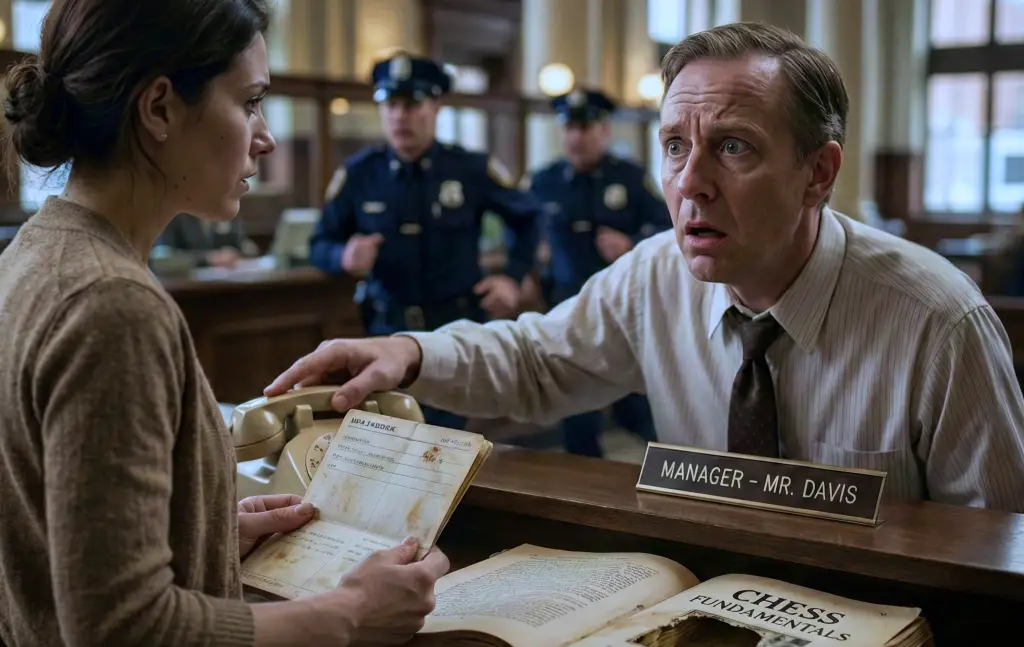
The bank manager’s complexion drained of all color, turning the shade of old parchment. His hands, previously steady, developed a noticeable tremor as he reached for the receiver on his desk.
“Lock the front doors,” he instructed his assistant, his voice tight with an urgency that made my stomach turn. “And call the police.”
“Now,” he added, looking at me across the mahogany desk. He stared at me as if I had just placed a ticking time bomb on his blotter rather than my late grandfather’s weathered passbook.
It was the very same passbook my mother had tossed into the kitchen trash only twenty-four hours earlier. She had dismissed it as worthless debris that should have remained buried with him.
She had been so absolute in her certainty that it meant nothing. It turns out that some secrets refuse to decay in the grave, and some of them have teeth sharp enough to bite. But I am getting ahead of the story.
Allow me to start from the beginning. My name is Danica Gross. I am thirty-one years old.
Until that specific Tuesday morning, I labored under the impression that the most adrenaline-pumping event of my week would be another futile argument with my landlord regarding the radiator. I work as a paralegal at a boutique law firm in Columbus, Ohio. It is not a glamorous life.
The salary is modest at best. My vehicle is a twelve-year-old sedan that emits a noise reminiscent of a dying whale whenever I attempt a left turn. However, I excel at my profession because I possess a specific skill: I notice details.
I ask the uncomfortable questions. I do not release my grip until I have unearthed the answers. My family has always categorized this persistence as a character flaw.
The funeral took place on a Tuesday. My grandfather, Eugene Gross, had departed this world at the age of eighty-nine. He had resided on a humble farm situated roughly two hours outside the city limits. It was a property boasting a wraparound porch and fields that seemed to stretch endlessly toward the horizon.
Everyone operated under the assumption that he had nothing—just an elderly man in a dilapidated house, living out his twilight years in quiet, frugal simplicity. That is certainly the narrative my mother wished to propagate.
The service itself was small, brutally efficient, and devoid of warmth, which was classic Miriam style.
My mother has always adhered to the philosophy that displaying emotion is a symptom of weakness. She treats funerals with the same detachment as corporate quarterly reviews. She orchestrated the entire affair with military precision.
Thirty minutes were allocated for the ceremony, forty-five for the reception, and then a prompt dismissal of all guests. There was to be no lingering, no unnecessary shedding of tears.
The catering was sourced from an establishment that evidently considered mayonnaise to be a primary food group. My grandmother would have clawed her way out of the earth just to lodge a formal complaint about the quality of the potato salad. She had standards. Miriam does not.
My brother, Wyatt, arrived forty minutes late, wearing a bespoke suit that cost more than the current market value of my car.
“Parking was difficult,” he claimed.
The farmhouse possesses a gravel lot roughly the dimensions of a football field, but sure, Wyatt—parking. He barely registered any sadness. Then again, Wyatt has never been particularly adept at simulating emotions that do not yield him a direct profit.
He offered a stiff hug to our mother, shook a handful of hands, and spent the majority of the reception glued to his smartphone. He was likely monitoring his portfolio. Wyatt loves nothing more than discussing his investments.
I stood in the periphery, observing my family perform their grief like actors in a low-budget stage play. My thoughts drifted to my grandfather. Eugene Gross had been an accountant for four decades. Numbers were his native tongue.
He possessed the ability to glance at a spreadsheet and perceive narratives that remained invisible to others. He was also a chess player, and a formidable one at that.
He taught me the game when I was seven years old, seated on that very wraparound porch. The board sat between us, a pitcher of lemonade sweating in the humid summer heat.
He often told me that chess wasn’t about the pieces you managed to capture. It was about the strategic positions you created, the traps you laid, and the discipline to wait for your opponent to blunder.
His favorite aphorism was simple yet profound.
“The truth is patient,” he would say. “It can wait longer than any lie.”
I never truly grasped the depth of that statement, not until the events of this week unfolded. Two weeks prior to his death, I had visited him at the farmhouse.
He was frail then. His body was betraying him, shutting down by inches, but his eyes remained sharp, focused, and intensely alive. He had gripped my hand with a strength that surprised me and pulled me down close to his lips.
His voice was a mere rasp, but every syllable was deliberate.
“The passbook,” he whispered. “In my study. The chess book. Only you, Danica. Promise me.”
“I promise,” I said. I didn’t understand the context, but I gave him my word.
After the funeral service concluded, the family reconvened at the farmhouse. Miriam was already pacing through the rooms like a shark. She was discussing the liquidation of the property, debating potential buyers, and calculating square footage while the earth over his coffin was still fresh.
Wyatt nodded along, occasionally interjecting with financial suggestions. It was obvious they had pre-gamed this strategy, likely while Grandpa was still breathing.
I slipped away unnoticed into his study. It was a compact room lined with floor-to-ceiling bookshelves, permeating the scent of aged paper and pipe tobacco. Grandpa hadn’t smoked in twenty years, but the aroma was woven into the woodwork.
I located the chess book immediately. Strategic Endgames: A Master’s Guide. It was his most cherished volume. We had analyzed the positions within those pages a hundred times over the years.
I pulled it from the shelf, and it felt wrong in my hands—too heavy, the balance shifted. I opened the cover, and my heart skipped a beat.
The interior pages had been hollowed out with a blade. Nestled inside the cavity was an old leather passbook, the edges worn soft. It was the kind of banking relic you might stumble upon in an antique shop. It looked ancient, an artifact from a bygone era.
I carried it into the living room, fueled by curiosity and a naive desire to share this final discovery with my family. That was a tactical error.
Miriam spotted the object before I could utter a word. Her reaction was visceral—too fast, too sharp to be natural. She crossed the room in three aggressive strides, snatched the booklet from my grip, and barely spared it a glance before hurling it directly into the kitchen trash can.
“This is garbage,” she declared, her voice pitching up. “Old accounts that don’t even exist anymore. This should have stayed buried with him. Don’t go digging through his things, Danica. It’s not appropriate.”
Wyatt laughed from the sofa, a sound devoid of mirth.
“Always the sentimental one, aren’t you, Dani?” he sneered.
They exchanged a look—brief, almost imperceptible, but I caught it. I have spent eight years working in law. I recognize that look.
It is the glance conspirators exchange when they share a dangerous secret. It is the look of fear when someone inches too close to a truth they intend to keep buried.
That night, sleep eluded me completely. I lay in bed, replaying my mother’s reaction on a loop. If the passbook was truly worthless trash, why the anger? Why not simply be dismissive? Why the urgent need to discard it so decisively?
And I kept thinking about my grandfather, his piercing eyes, his deliberate instructions. He was an accountant for forty years. He did not make errors with documentation.
If he had gone to the trouble of concealing that passbook inside a hollowed-out book and entrusted its location only to me, there was a specific reason. People only react with that level of hostility when they have something to hide.
At five o’clock in the morning, I made an executive decision. I was going back to the farmhouse. That passbook was likely still sitting in the refuse, and I was going to discover exactly why my mother wanted it obliterated.
The drive to the farmhouse took two hours in the bleak, gray light that precedes dawn. I kept the radio silent. I needed the quiet to think.
My grandfather was many things—patient, methodical, strategic. He had spent four decades tracking discrepancies and balancing ledgers. He played chess like a man who could visualize fifteen moves into the future. He did not do things at random.
He did not hide passbooks in hollowed-out literature and whisper cryptic deathbed instructions unless the stakes were real. My mother did not throw items into the trash with that level of aggression unless she was afraid.
I pulled up to the farmhouse just as the first rays of sunlight were bleeding purple and gold across the fields. There were no other cars in the lot. No witnesses. Perfect.
I let myself in using the spare key Grandpa kept hidden beneath the third porch step. The house was tomblike, silent and still. I went directly to the kitchen.
The trash can was exactly where I had last seen it. I hoisted the bag out, set it on the linoleum, and began to dig. There I was, a grown woman with a university degree, elbow-deep in kitchen refuse at 5:30 in the morning, resembling a raccoon in business casual attire.
My grandfather would have been proud of the tenacity. My therapist would have had significant concerns.
The passbook was near the bottom, buried beneath wet coffee grounds and crumpled paper napkins from the funeral reception. I retrieved it, wiped the cover clean with my sleeve, and examined it properly for the first time.
The leather exterior was indeed old and distressed, designed to look decades out of date. But when I flipped it open, the illusion shattered.
The account number printed inside did not match the vintage aesthetic. The format was wrong. Too many digits. Too modern.
And then I found the note.
Tucked tightly into the spine of the passbook, folded into a microscopic square, was a slip of paper bearing my grandfather’s meticulous handwriting.
Account number 7-7-4-1-2-2-8-9. They don’t know about this one. Ask for the full history. Trust no one in the family. Only you, Danica.
I read the words three times to ensure I wasn’t hallucinating. They don’t know. Meaning Miriam. Meaning Wyatt.
My grandfather had concealed something from his own son and daughter-in-law. He had trusted only me to unearth it. I immediately took photographs of everything—the passbook, the handwritten note, the account number.
I uploaded the images to my secure cloud storage before I even stood up. Working at a law firm instills certain paranoia-fueled habits. Documents can be shredded. Physical files can be “lost.” But digital backups are eternal.
I drove home with the passbook secured in my purse and a thousand questions burning in my mind. The first phone call arrived at ten that morning. It was Miriam.
Her voice was sugary sweet. Concerned. Motherly. Everything she isn’t.
“Just checking on you after yesterday,” she purred. “Such a hard day for all of us.”
I waited. The hook was coming.
“You didn’t take anything from the farmhouse, did you?” she asked, the sweetness straining at the edges. “Everything belongs to the estate now. We need to catalog it properly before the sale.”
I lied with professional smoothness.
“Just one of Grandpa’s chess books,” I said. “For the memories.”
There was a pause on the line. I could practically hear the gears in her head turning, calculating whether to push harder. Then her voice relaxed.






Comments are closed.