
She turned to my father. “Mr. Thompson, you signed an affidavit stating you witnessed conversations about sharing. Do you stand by that?”
My father’s voice was low, barely a rumble. “We thought… we thought it was understood.”
“Understood,” the judge said, “or assumed after the fact?” She looked at my mother. “Mrs. Thompson?”
My mother didn’t lift her eyes. “We just wanted what was fair.”
The judge leaned back in her chair. “Fairness is not determined by who benefits after the work is done. This court sees a pattern: pressure applied only when the asset became valuable. No evidence of prior agreement. No financial contribution from the plaintiff. And clear attempts to coerce transfer.”
She addressed Dylan directly. “Your claim relies on portraying your sister as incapable. Yet the records show consistent management, growth, and responsibility on her part. The evidence contradicts your narrative entirely.”
The room stayed still. No murmurs now. Just the crushing weight of the truth. James returned to his seat. He didn’t smile. He didn’t need to. I sat without moving.
The judge returned after a short recess. The courtroom was silent, the kind of quiet that presses against your skin. She sat down, folded her hands, and looked across the room at each of us in turn. When her gaze reached me, it lingered for a moment longer.
“I have reviewed all the evidence,” she began, her voice steady and deliberate. “The plaintiff’s claim rests on an alleged verbal agreement to share ownership of the yoga studio and associated vehicle. The supporting affidavits and testimony suggest emotional instability on the part of Ms. Thompson as the basis for intervention.”
She paused, letting the words settle like dust. “However, the defense has presented clear documentation: financial records showing sole responsibility for all improvements, purchases, and operational costs. Communications from the plaintiff only appear after the business gained measurable value. And, most significantly, a recorded conversation in which the plaintiff explicitly pressures Ms. Thompson to sign over ownership under threat of litigation.”
She turned to Dylan. “This is not concern. This is opportunism.”
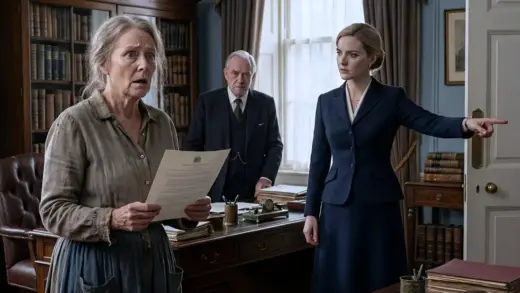
Dylan sat rigid, pale as a sheet. His lawyer made a small movement, but the judge continued. “The court finds no credible evidence of any prior agreement. The handwritten will from Mr. Harold Thompson is unambiguous: full ownership to Ms. Alexandra Thompson. No financial contribution from the plaintiff has been demonstrated. No pattern of shared management exists.”
“The claim is denied in its entirety.” She looked at Dylan and my parents. “Furthermore, any continued attempts to harass, coerce, or challenge Ms. Thompson’s ownership may result in additional legal consequences, including contempt or civil penalties. This matter is closed.”
The gavel struck once—sharp and final. The room exhaled. A few people in the gallery shifted in their seats. My father stared straight ahead, his jaw working. My mother’s hands trembled slightly in her lap. Dylan looked like he was going to be sick.
I stood up. For the first time that day, I spoke. “Your Honor,” I said, my voice clear in the stillness. “May I address the court?”
Judge Ramirez nodded. “You may.”
I turned slightly toward my family. They looked smaller somehow, diminished by the light of the truth.
“I’ve spent my entire life being told who I am,” I said. “That I’m responsible, but not capable. That I’m hardworking, but not visionary. That I should step aside because someone else deserves more. No one ever asked how I was doing when I worked two jobs to pay for the studio. No one came to see the late nights, the repairs, the classes I taught when I was exhausted.”
“No one offered help. You only noticed when it started to succeed.” I paused. The words came easily now, flowing from a deep reservoir of years.
“You signed statements saying I was unstable. You said I needed protection. But the only thing I needed was to be left alone to do what I’ve always done: take care of myself. Because you never did.”
My father opened his mouth to speak, then closed it. My mother looked down at her lap. Dylan stared at the floor.
“I’m not angry,” I continued. “I’m just done.”
I sat back down. The judge gave me a small nod—nothing dramatic, just an acknowledgement of respect. Then she rose. The bailiff called court as adjourned.
I gathered my things. James Whitaker touched my arm lightly. “You did well,” he said. I thanked him and walked out without looking back.
Outside, the air was sharp and clean. I stood on the steps for a moment, letting the noise of the city wash over me. There was no sense of triumph, just a profound sense of release.
That evening, I went back to the studio. The last class had ended hours ago. I locked the door behind me, turned off the main lights, and left only the soft glow above the mirrors. I sat on the floor in the center of the room, legs crossed, hands resting on my knees.
The space was quiet. No music, no voices, just the faint hum of the heater and the occasional creak of the old building settling into the night. I thought about the years before—the silence I had carried like armor, the nights I had worked alone, the moment I realized speaking up never changed their minds.
Today, I had spoken. Not to convince them, but to close the door. My phone buzzed in my bag. I pulled it out. Messages from my mother: We need to talk. A voicemail from Dylan: This isn’t over.
I listened to none of them. I opened my contacts. One by one, I blocked their numbers. Then I blocked them on every social platform. I didn’t hesitate. I didn’t explain.
Weeks passed. Word spread quietly in the local community. People who knew Dylan from school or neighborhood events heard about the lawsuit. Some stopped going to his occasional fitness classes. Others whispered at the park sessions.
No one confronted him directly, but the bookings dropped. Students chose the studio that felt safe, not the one tied to ugly family drama. My parents faced their own quiet consequences. Neighbors who used to wave now nodded politely and kept walking.
Friends from church asked careful questions, then stopped asking altogether. They weren’t shunned, just distanced—a subtle shift that happens when people choose sides without saying a word. I didn’t gloat. I didn’t check on them. I simply lived.
Every evening after the last student left, I closed the studio myself. I turned off the lights, locked the door, and sat for a few minutes in the dark room. The mirrors reflected nothing but stillness. That was enough.
For the first time in my life, I understood that silence wasn’t weakness. It wasn’t endurance. It was a choice—a deliberate decision to protect what I had built, to guard the space I had earned, and to refuse anyone who thought they could take it simply because they believed they deserved it more.
I had carried silence for so long it felt like part of my DNA. Now, it was mine to use, not theirs to demand. And in that quiet room, with the world outside moving on without me waiting for approval, I finally felt at home.








Comments are closed.