
Snow still clung stubbornly to the hems of Ethan’s trousers by the time he navigated the truck into his Brooklyn neighborhood. It was a quiet, forgotten pocket of the borough, a dense patchwork of aging brick facades and narrow, salt-stained streets now half-buried beneath gray slush. The light spilling from the surrounding apartment windows was a weak, bruised yellow, flickering faintly behind heavy curtains that looked as though they hadn’t been drawn back in a decade.
His breath plumed in thick white clouds as he shouldered open the heavy front door of his three-room walk-up. The rusted iron hinges groaned a harsh protest that echoed up the dark stairwell. Inside, the ambient temperature was barely higher than the street, cold enough to make the joints of his fingers ache with a dull throb. Ethan carried his burden with careful, measured steps, setting the heavy metal cage down gently on a frayed wool rug positioned squarely in front of the baseboard heater. The radiator was an archaic relic from the nineteen-eighties, a rusted metal box that rattled endlessly and hummed with phantom effort, yet rarely managed to truly strip the chill from the room.
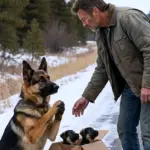
The German shepherd immediately pressed herself deep into the furthest corner of the wire enclosure. She was still trembling violently, but her posture was hyper-alert, her dark, tracking eyes locked onto Ethan’s every microscopic shift in weight. The two puppies were mashed into a pathetic, shivering heap against her ribs, their breathing a frantic, shallow flutter. Ethan lowered himself to his knees. His fingers were stiff and raw from the cold as he worked the rusted latch free.
“Easy,” he murmured, his voice a low, gravelly vibration. “You’re safe now.” The syllables slipped out quietly, carrying the distinct cadence of a man who was trying just as hard to convince himself.
He reached in and lifted the mother first. The physical reality of her condition was a shock; she was astonishingly light, her ribs jutting like sharp, fragile ridges beneath her matted coat. A raw, inflamed laceration was clearly visible just above her left front paw. As his hands closed around her torso, she didn’t fight, didn’t snap, and didn’t pull away. She merely released a long, shuddering exhale, allowing her heavy head to drop forward in absolute, total exhaustion. He wrapped her securely in one of the thick wool blankets Sarah had provided. Then, with agonizing care, he reached back inside and extracted the puppies one by one. Their tiny bodies held a faint, residual warmth, but they were deeply lethargic—a terrifying, unnatural stillness that made Ethan’s own pulse accelerate with sudden dread.
His apartment offered no distractions. The space was strictly utilitarian, furnished with only the barest necessities: a narrow, tightly made cot pushed flush against one wall, a compact gas stove, and a single, battered armchair that bled yellow foam stuffing from its split seams. The walls were devoid of art or comfort. The only decorations were a simple wooden cross hanging slightly askew above the doorframe, and a framed, sun-faded photograph resting on the counter. The image captured Ethan and his former SEAL team—six heavily geared men standing shoulder-to-shoulder in blinding, washed-out desert light, their smiles suspended somewhere in the brutal intersection of fierce pride and bone-deep fatigue. Ethan had actively avoided making eye contact with that photograph for three straight months. Looking at it tonight, the faces belonged to an entirely different lifetime.
Shifting his focus, he filled a dented aluminum pot with tap water, his movements rigid and automatic. He set the pot onto the stove and struck a match. The sudden, sharp hiss of the blue gas flame shattered the heavy silence of the room. Ransacking his sparse pantry, he located a half-empty, crumpled bag of white rice and a single tin of canned ham—the absolute closest approximation of a restorative meal he could currently provide. As the water boiled and the ingredients mixed, a thick, savory scent began to permeate the freezing air, offering a mild, grounding comfort.
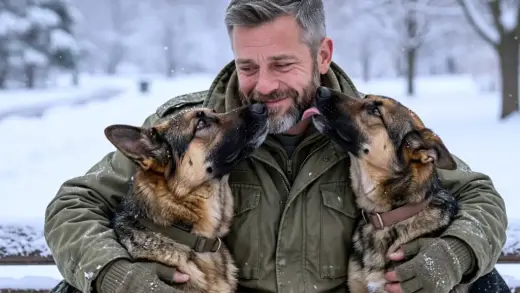
Behind him, he heard the heavy rustle of wool. The German shepherd was standing unsteadily on her paws. Her tail was tucked low between her hind legs, but the very tip swayed with a faint, hesitant rhythm. As the ice melted from her coat near the struggling heater, Ethan could finally see her true structure. She was incredibly young—perhaps three years old at most. Her drying fur revealed an inherently beautiful, rich patterning of deep black and rusted tan, though the colors were severely muted by malnutrition and neglect. Her eyes tracked his every movement across the small kitchen, still carrying a heavy guard, yet distinctly softening.
“You’re tougher than you look,” he murmured, abandoning the stove to crouch beside her once more. He extended his right hand, keeping his palm flat and open.
She leaned forward, drawing his scent deeply into her nostrils. Then, after a long, deliberate pause, she closed the remaining distance and pressed her damp, cracked nose firmly into the pulse point of his wrist. The simple, profound weight of the gesture sent a sudden, startling spike of warmth rushing through Ethan’s chest—a heat that had absolutely nothing to do with the rattling radiator.
He carefully inspected her injured paw, taking a damp, clean cloth to gently wipe the grime and dried blood away from the laceration.
“You’ll be fine,” he told her, the absolute faintest ghost of a smile touching the corners of his mouth. “You made it this far.”
Once the makeshift rice porridge had cooled to a safe temperature, he poured a generous portion into a shallow ceramic bowl, using a fork to mash the chunks of canned ham into a soft, digestible paste. He placed the dish carefully on the floor beside the blanket. The mother dog hesitated for only a fraction of a second before lowering her head. She ate with surprising grace, consuming the food slowly and neatly despite her obvious starvation. When she had taken enough to sustain herself, she immediately stopped and used her muzzle to push the heavy bowl directly toward her hidden litter. The smaller puppy—a frail thing barely half the physical mass of its sibling—dragged itself clumsily over the folds of the wool blanket and began to lap desperately at the warm broth.
Ethan watched the exchange, feeling a sudden, physical tightness grip his throat.
He sank back onto the hard wooden floorboards, crossing his legs, and simply observed them. For the first time in an agonizingly long stretch of months, the absolute silence of the apartment did not feel suffocating or oppressive. It felt thick. It felt full. He leaned the back of his head heavily against the drywall and spoke into the quiet room.
“Hope. Scout. Tiny.”
He extended a calloused index finger as he spoke, pointing deliberately. First to the protective mother, then to the slightly larger, bolder puppy, and finally to the fragile, shivering runt. “That’s you three.”
The names locked into place with an undeniable rightness. The mother, Hope, lifted her regal head, her ears swiveling forward as if formally acknowledging the new title. The two pups, their small bellies finally rounded and tight with warm food, squirmed deeply into the folds of the army-green blanket and closed their eyes.
Outside, the relentless winter wind violently rattled the loose windowpanes in their wooden frames. The freezing snow tapped a frantic, rhythmic code against the glass. Ethan rose and idly stirred the remaining porridge in the pot, the repetitive motion born more out of ingrained habit than actual hunger. He was entirely unaccustomed to sharing his space. The cabin-like, profound loneliness of this walk-up had served as his deliberate refuge from a world that moved too fast. Yet now, the sterile room suddenly seemed physically smaller, holding a contained, living warmth.
Several floors above his ceiling, the heavy, distinct thud of a door clicking shut echoed down the stairwell. In this particular pre-war building, ambient sound traveled through the floorboards like malicious gossip. Ethan instinctively ignored the noise, his mind categorizing it as non-threatening background data. But a minute later, the silence was broken by a soft, remarkably hesitant sequence of knocks against his own front door.
He frowned, his brow furrowing in deep suspicion, and pulled the door open exactly halfway, his body instinctively blocking the threshold.







Comments are closed.