
Winter mornings in Manhattan possessed a brittle, unforgiving beauty. The overnight snowfall clung to the cornices of pre-war buildings and weighed down the canvas awnings along the avenues, temporarily softening the city’s sharp, concrete angles. Vents set into the asphalt exhaled thick plumes of steam that twisted into the iron-gray sky, while the subterranean pulse of subway trains and distant commuter traffic provided a steady, thrumming heartbeat beneath the frozen pavement.
Fifth Avenue was already a river of hurried motion. It was a rhythm built on the clicking of leather heels, the heavy thud of winter boots, and the collective forward momentum of a populace that simply did not have the time or the inclination to look down. Ethan Walker moved through the current without a destination. He navigated the crowded sidewalk with the loose, measured stride of a man accustomed to long, unforgiving treks. He was tall and broad across the shoulders, a physical framework forged by years of grueling endurance rather than the comforts of an easy life.
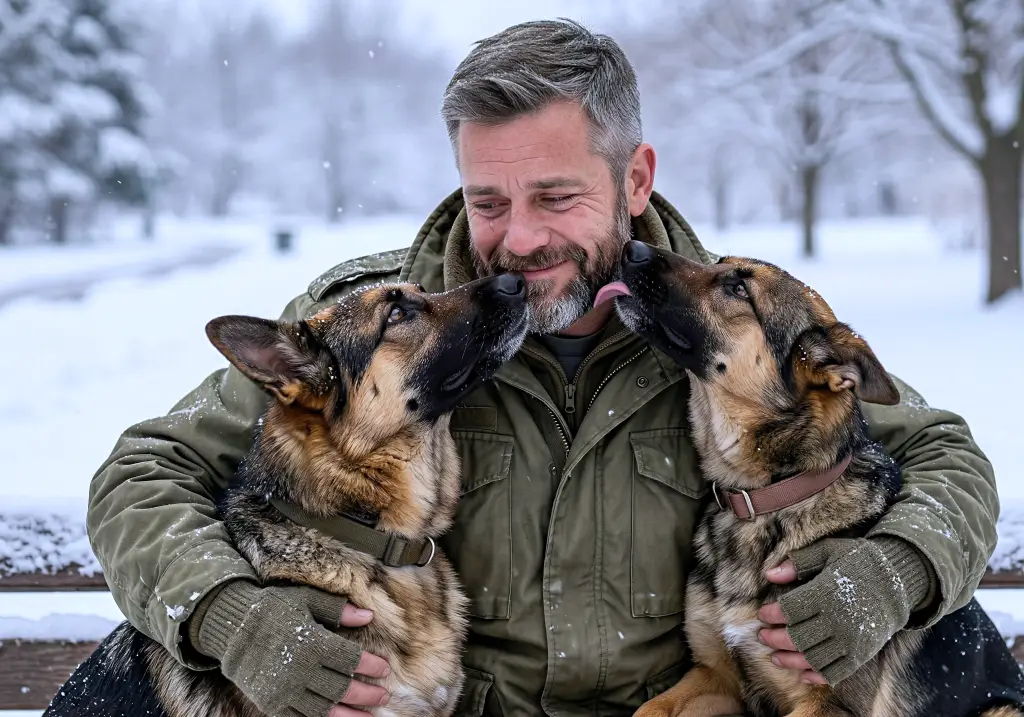
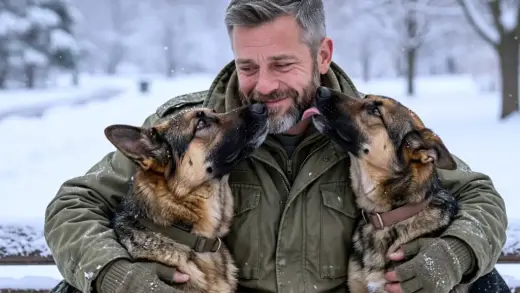
At thirty-eight, his dark brown hair was cropped military-close, dusted with premature gray at the temples. A neatly trimmed beard traced the line of a jaw that seemed locked by habit rather than vanity. He still carried the rigid, unmistakable posture of a Navy SEAL. The jacket he wore against the morning chill—a faded Navy Working Uniform Type III in muted green, gray, and brown digital camouflage—no longer signified an active command or a pending mission. It was merely a functional relic of a past he couldn’t entirely shed. His storm-gray eyes absorbed the ambient light of the morning rush but reflected none of it, scanning the urban landscape with the detached vigilance of a ghost.
He had been back stateside for three months, yet the concept of home remained an abstract idea, a word hollowed out by absence. Sleep offered no refuge. His nights were plagued by the abrasive sting of phantom sandstorms, the chaotic static of broken radio transmissions, and the frantic, echoing barks of military working dogs that never faded into the dawn. Every morning, he was jolted awake not by the familiar chop of helicopter rotors or the crash of the tide, but by the mundane hum of his apartment refrigerator and the drone of sanitation trucks. He was supposed to be at peace. Instead, the quiet felt like an entirely new geography of exile. So, he walked. He pushed himself through the biting frost and the suffocating noise, putting miles beneath his boots just to verify that his legs still worked, that he was still moving forward.
It was near the intersection of East 72nd Street that the anomaly broke through his peripheral vision. A rusted wire cage sat crookedly beside a cast-iron lamppost, its lower half already swallowed by a rising snowbank.
Initially, his mind categorized it as discarded debris, perhaps the forgotten remnants of a street vendor’s stall or trash left behind by a careless tenant moving out. But as the gap between them closed, the crude signage came into focus. Taped across the top bars was a piece of warped cardboard. Written in thick, bleeding black marker were two words: For Sale.
Ethan stopped. The flow of pedestrian traffic parted around him, an irritated stream flowing past a sudden stone.
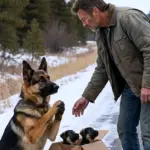
The enclosure was far too small, its metal joints bleeding orange rust, the crossbars coated in a thick rime of white frost. Inside, pressed into the furthest corner, lay a German shepherd. She was curled into a tight, desperate crescent, wrapping her body around two tiny pups. Her coat, which should have been dense and vibrant, was matted with street grime and stiff with ice. Violent shivers racked her frame, yet she maintained her protective coil over her young. The puppies were pressed deep into the sparse warmth of her chest, their miniature forms completely motionless save for the agonizingly shallow rise and fall of their ribs.
For a long, suspended moment, Ethan simply stared.
Behind him, the city continued its relentless march. Boots crunched over salted ice. Cell phones chimed and buzzed. Snippets of conversation were snatched away by the wind. No one slowed their pace. A woman bundled in a heavy red wool coat swept past, briefly casting her gaze downward.
“Poor thing,” she muttered into her scarf, her stride never breaking as she vanished into the throng.
A deep, resonant ache bloomed in the center of Ethan’s chest. It wasn’t the searing heat of anger, at least not yet. It was the heavy, sinking weight of recognition. He knew the look in the mother dog’s eyes. It was the hollow, exhausted stare of a living creature that had waited for a rescue that was never coming. He had seen that exact expression on the faces of emaciated strays wandering the rubble of foreign deployments. He had seen it staring back at him from his own bathroom mirror in the quiet hours following a teammate’s funeral.
Without a conscious thought, Ethan crouched. The movement was fluid, practiced, and entirely devoid of threat. Instantly, the shepherd stiffened. Her frostbitten ears twitched flat against her skull, and her skeletal body coiled tighter, gathering whatever meager strength she had left to defend her litter.
Ethan kept his hands empty and visible, resting them on his knees.
“Hey there,” he murmured. His voice was a low, steady baritone, pitched to cut through the wind without adding to the noise. “Easy. It’s all right.”
The mother shifted her head. Her eyes rose to meet his. They were a bottomless, glassy brown, the sclera inflamed and ringed with red from severe cold and sheer exhaustion. Her breath hitched in shallow pants, pushing small clouds of white vapor through the rusted bars. She did not bare her teeth. She did not growl. She merely watched him, evaluating his presence with the same hyper-vigilant patience Ethan had once utilized while clearing hostile rooms in absolute silence.
His gaze drifted to her neck. A thin, cheap nylon collar choked her throat. The edges were frayed and torn, the material fastened far too tight against her skin. This wasn’t a case of a lost pet wandering away from a cracked door. The placement of the cage, the sign, the location—whoever had done this had executed it with deliberate, calculated cruelty. Ethan’s mind automatically constructed the timeline: the screech of tires against the curb, the heavy slam of a car door, the receding glow of taillights fading into the Manhattan gray, leaving a vacuum where loyalty had once resided.
Six stories above the frozen pavement, behind a window etched with intricate patterns of frost, Eleanor Pierce sat with her morning tea. At seventy years old, her hair was a soft, spun silver, framing a face lined with a lifetime of quiet observation. Her apartment was modest and impeccably kept, smelling perpetually of dried chamomile and aged paper, the walls lined with towering bookshelves and framed photographs. She had spent decades commanding a classroom as an English teacher at the local public high school. Now, in her retirement, the boundaries of her world had drawn inward, often reduced to the rhythmic theater of strangers passing on the avenue below.
Winter had always carried a specific, lingering weight for Eleanor since the passing of her husband, Richard, a full decade prior. Richard had been a Vietnam veteran, a man who had returned from the jungle with incredibly gentle hands and a deeply haunted gaze.
Peering through the glass, Eleanor noticed the man in the camouflage jacket halt beside the lamppost. She watched as he lowered himself into a crouch. There was a distinct deliberation in the way he moved, a heavy grace that reminded her of a man lowering himself into a trench of memories. Something in the absolute straightness of his spine and the profound stillness of his hands sent a shock of recognition through her chest. She knew that specific brand of stillness. It was the exact posture Richard used to adopt when the noise of the world became too loud, when words felt too fragile to speak aloud lest they shatter entirely.







Comments are closed.