
Emily pressed a hand against her chest, over the logo on her sweatshirt.
“Are you saying the sale is invalid?”
“I am saying,” I replied slowly, “that this isn’t what you think it is. And unfortunately, you will need legal help to sort it out.”
My father stepped closer, his voice shaking with a volatile mixture of anger and fear.
“Maria, don’t do this. We are family.”
“That didn’t stop you,” I said, cold as ice. “Family didn’t matter when you needed quick cash.”
“It was for your brother!” he shouted, desperation leaking into his tone.
“And what about me?” I asked quietly. “When did I stop being your child? When did I become expendable?”
For the first time since I had stepped onto that porch, he had no answer. The silence stretched, heavy and suffocating.
Emily finally spoke again.
“What do we do now?”
“You,” I said, looking her in the eye, “get a lawyer. And you tell them everything. And you stop speaking to my father outside of official channels. Because the deeper you let yourself get involved with this situation, the worse it will be for you.”
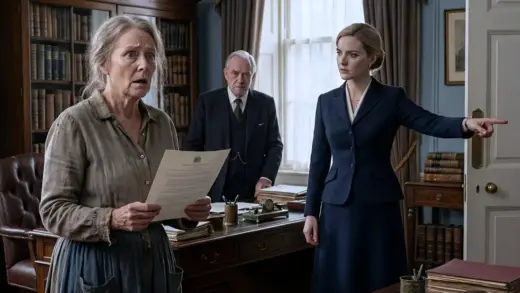
She nodded slowly, clutching her mug like it was the only solid object left in her world. My father pointed a finger at me, shaking.
“You are ruining everything.”
I shook my head, a sad, final movement.
“No, you ruined everything the minute you treated my service as an opportunity instead of a sacrifice.”
Chad muttered something about “Marine attitude,” but I barely heard him. I was already stepping off the porch, lifting my sea bag again, my boots crunching against the gravel. The air felt sharp and cold, but in a way that cleared my mind rather than clouded it. I started walking toward the street.
My father yelled behind me.
“Where are you going?”
“Home,” I said.
“You don’t have one!” Chad shouted, his voice cracking.
I turned back toward them one last time, letting the porch light cast a halo behind their silhouettes.
“That,” I said, “is what you think.”
And then, for the first time since landing, I actually felt calm. Because the truth was, they had no idea how much trouble they had created for themselves. No idea what the next days would bring. No idea how unprepared they were for the consequences. And I didn’t need to frighten them with details. Fear grows best when it is left unexplained.
I didn’t sleep that night. I checked into a cheap roadside motel, the kind with the buzzing neon sign that stained the curtains red and a humming air conditioner that rattled louder than the traffic on the interstate. I set my sea bag on the fraying upholstery of the chair, sat on the edge of the mattress, and stared at my phone. My father’s number flashed across the screen three times before I finally put the device face down on the nightstand and let it ring out. I wasn’t ready to talk to him. Not when my chest still felt tight and my pulse still jumped every time I replayed the moment on the porch.
I thought about Emily’s stunned face, the way she clutched that coffee mug like a lifeline. I thought about Chad’s guilt dressed up as bravado, a costume he had worn since high school. And about my father—his anger, his excuses, his insistence that what he had done was “for the family.” People love to use the word family when they need something from you. It is amazing how rarely they use it when you need something from them.
The motel room smelled like old carpet and lemon cleaning spray, a scent that somehow made the loneliness sharper. I took a scalding shower just to wash off the travel dust and the lingering feeling of the driveway, but even after the hot water ran cold, the heaviness didn’t lift. So I sat back on the bed, turned on the little lamp that cast a yellow, sickly light, and pulled out the folder I had been carrying since Okinawa.
Paperwork. Notes. Screenshots. Emails. Everything I had gathered in those final weeks overseas when the truth had started taking shape. It hadn’t happened all at once. Betrayal rarely does. It starts with little cracks, uneasy silences, vague explanations, half-finished sentences. Then one day the dam breaks, and you realize every red flag had been trying to warn you.






Comments are closed.