
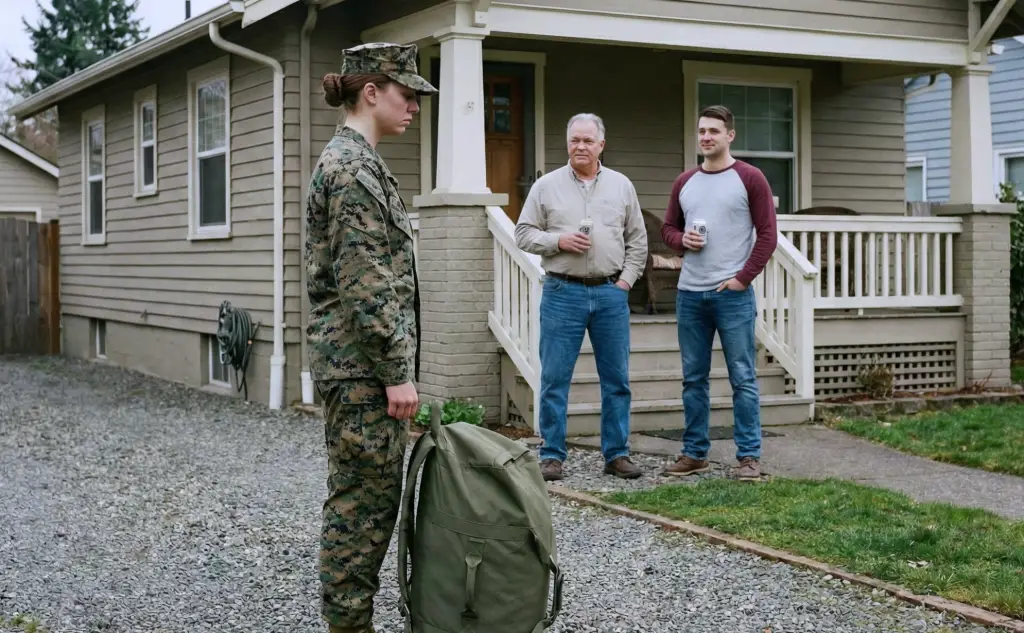
The tires of the taxi crunched over the loose gravel of the driveway, the sound sharp and rhythmic, signaling the end of a long journey and the beginning of something I hadn’t yet anticipated. We had barely come to a halt before I realized the atmosphere was wrong. Wrong in the way the air feels before a thunderstorm breaks. They were already there, waiting for me.
My father and my older brother, Chad, stood on the porch, leaning against the railing with a posture that sat somewhere between arrogance and nervous anticipation. They were smirking. It was that specific, conspiratorial look two people share when they are in on a joke that is about to absolutely ruin your day. The strap of my sea bag dug into my shoulder, heavy with the weight of my gear, and my boots were still coated in the fine, pale dust they had collected thousands of miles away in Okinawa. I felt the physical weight of my service, but as I looked at them, I felt a different kind of heaviness settling in my gut.
I hadn’t even taken three full steps toward the house—my house—before my father delivered the news. He didn’t say hello. He didn’t ask how the flight was or if I was tired. He didn’t offer a welcome home hug. He just looked me dead in the eye and spoke four words that landed harder than any physical blow I had ever taken in the ring.
“You are homeless now.”
He said it so casually, tossing the words out as if he were commenting on the weather or the traffic. I froze in my tracks, my boots glued to the pavement, my brain struggling to process the auditory input against the reality of what I was seeing.
“What are you talking about?” I asked, my voice coming out lower and rougher than I intended, the gravel of the road seemingly stuck in my throat.
My brother, Chad, lifted a beer can to his lips, took a long, noisy swig, snorted into the rim, and then wiped his mouth with the back of his hand in a slow, deliberate motion.
“We sold your house, sis. Try to keep up.”
They actually laughed. It was a dry, cruel sound that scraped against my nerves. They stood there on the porch of the home I had paid for, laughing at their daughter and sister who had just returned from an overseas rotation only to find her entire world erased. My father waved a hand lazily toward the front door, dismissing the gravity of the situation as if it were a minor inconvenience, like a lost set of keys.
“Your brother needed help,” he said, his tone matter-of-fact, void of any apology. “Family sacrifices for family. You weren’t here. You didn’t need the place.”
Then he added the part that cut the deepest, the part that revealed exactly how little they respected the life I had built, the discipline I lived by, and the sacrifices I had actually made.
“You Marines bounce around anyway. What difference does a house make to you?”
I should have exploded. The old me, the teenager who used to slam doors and scream until her throat was raw, probably would have. I should have cursed them until the neighbors called the police. I should have fallen apart right there on the lawn, sobbing into my sea bag. But I didn’t. Instead, a slow, steady smile spread across my face. It wasn’t a happy smile; it was the kind of smile that makes people shift their weight and check the exits. It was the smile of a predator realizing the prey has just made a fatal mistake. It made both of them frown.
“What is so funny?” my father snapped, his confidence faltering for the first time since I stepped out of the cab.
“The house you sold was actually…” I started, but I let the sentence hang there, suspended in the cool air.
Before I finish that thought, I need to take you back to how this nightmare began. Because the truth is, none of this was an accident. They didn’t stumble into this betrayal; they planned it. They orchestrated it. They just didn’t plan it nearly as intelligently as they thought they had.
It started about three months earlier. I was stationed in Okinawa, halfway through a standard six-month rotation. Shore duty isn’t exactly glamorous—it’s a mountain of paperwork, routine inspections, and humidity that clings to you like a second skin—but it is predictable. And in this line of work, predictability is a luxury Marines don’t get often. I used my off-hours to call home, checking on the house to make sure the pipes hadn’t burst and the place was still standing.
I had owned that property for eight years. I bought it myself after my second deployment, scraping together every cent I had saved while everyone else was buying new cars. I renovated it room by room on my own dime, tearing up rot-infested carpets and painting walls until my hands were blistered and my back ached. It was supposed to be my stability. My anchor. My future.
But every time I called home during that rotation, things felt… off. My father would answer the phone sounding irritated, clipped, as if my call was interrupting something far more important than his daughter. My brother Chad—the family’s eternal “finding himself” project who somehow never managed to find anything but trouble—had moved back in with Dad after losing yet another job. Whenever I asked what he was doing to get back on his feet, Dad would immediately jump to his defense, his voice rising in agitation.
“He just needs a little time. He is working on it. Don’t be so judgmental, Maria.”









Comments are closed.