
Leo looked at his mother. Sarah was crying openly now, covering her mouth with her hands. She nodded. Leo looked back at Arthur. He smiled a beautiful, gap-toothed smile.
“Deal,” Leo said.
He held out his small hand. Arthur Sterling, the billionaire who trusted no one, took the small hand in his and shook it.
Ten years passed.
The Sterling mansion was no longer a dark, silent mausoleum. The heavy curtains were always pulled back, letting the sunlight pour in. The garden, once overgrown and thorny, was a riot of bright flowers.
On a warm Sunday afternoon, the library was full of people. But it wasn’t a party. It was a somber gathering of lawyers, businessmen, and a young man named Leo.
Leo was seventeen now. He was tall, handsome, and wearing a crisp suit. He stood by the window, looking out at the garden where his mother, Sarah, was arranging flowers. Sarah didn’t look tired anymore. She looked radiant. She was now the head of the Sterling Foundation, managing millions of dollars given to charity every year.
The room was quiet because the lawyer was reading the last will and testament of Mr. Arthur Sterling. Arthur had passed away peacefully in his sleep three days ago. He had died in that same burgundy armchair, the very place where the test had happened ten years prior.
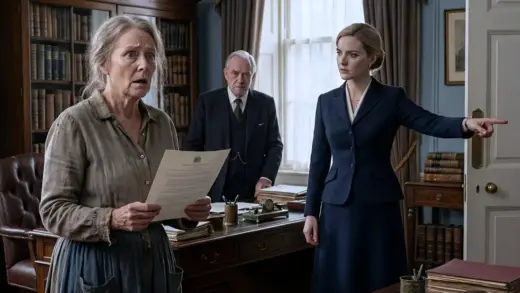
Arthur’s biological children were there—two sons and a daughter. They sat on the other side of the room, looking impatient. They checked their expensive watches constantly. They whispered to each other about selling the house and splitting the fortune. They didn’t look sad. They looked greedy.
The lawyer, Mr. Henderson, cleared his throat.
“To my children,” Mr. Henderson read from the document, “I leave the trust funds that were established for you at birth. You have never visited me without asking for money. So I assume the money is all you desire. You have your millions. Enjoy them.”
The children grumbled, but they seemed satisfied. They stood up to leave, not caring to hear the rest.
“Wait,” Mr. Henderson said. “There is more. To the rest of my estate, my companies, this mansion, my investments, and my personal savings, I leave everything to the one person who gave me something when I had nothing.”
The children stopped dead in their tracks. They turned around, confused.
“Who?” one son demanded. “We are his family.”
“I leave it all,” the lawyer read, “to Leo.”
The room erupted in shouting. The sons were furious. They pointed accusing fingers at Leo.
“Him?” they yelled. “The maid’s son? This is a joke. He tricked our father!”
Leo didn’t move. He didn’t say a word. He just held something in his hand, rubbing it gently with his thumb. The lawyer raised his hand for silence.
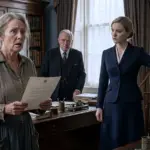
“Mr. Sterling left a letter explaining his decision. He wanted me to read it to you.”
The lawyer unfolded a handwritten note.
“To my children and the world: You measure wealth in gold and property. You think I am giving Leo my fortune because I have gone mad. But you are wrong. I am paying a debt. Ten years ago, on a rainy Saturday, I was a spiritual beggar. I was cold, lonely, and empty. A seven-year-old boy saw me shivering. He didn’t see a billionaire. He saw a human being. He covered me with his own jacket. He protected my money when he could have stolen it. But the true debt was paid when he gave me his most prized possession, a broken toy car, to save his mother from my anger. He gave me everything he had, expecting nothing in return. That day, he taught me that the poorest pocket can hold the richest heart. He saved me from dying as a bitter, hateful man. He gave me a family. He gave me ten years of laughter, noise, and love. So I leave him my money. It is a small trade, because he gave me back my soul.”
The lawyer finished reading. He looked at Leo.
“Leo,” the lawyer said. “Mr. Sterling wanted you to have this.”
The lawyer handed Leo a small velvet box. Leo opened it. Inside, sitting on a cushion of white silk, was the old toy car. Fast Eddie.
Arthur had kept it for ten years. He had polished it. He had even commissioned a jeweler to fix the missing wheel with a tiny piece of solid gold.
Leo picked up the toy. Tears ran down his face. He didn’t care about the mansion. He didn’t care about the billions of dollars or the angry people shouting in the room. He missed his friend. He missed the grumpy old man who used to help him with his math homework.
Leo walked over to his mother, Sarah, who had come in from the garden. She hugged him tight.
“He was a good man, Leo,” she whispered.
“He was,” Leo replied. “He just needed a jacket.”
The angry children stormed out of the house, vowing to sue, but they knew they would lose. The will was ironclad. Leo looked around the massive library. He looked at the empty armchair. He walked over to it and placed the toy car with the gold wheel on the side table, right next to the lamp.
“Safe now,” Leo whispered, repeating the words he had said ten years ago.
Leo grew up to be a different kind of billionaire. He didn’t build walls; he built schools. He didn’t hoard money; he used it to fix things that were broken, just like he had tried to fix the ruined chair. And every time someone asked him how he became so successful, Leo would smile, pull a battered toy car from his pocket, and say: “I didn’t buy my success. I bought it with kindness.”
Now, the moral of this story: Kindness is an investment that never fails. In a world where everyone is trying to take something, those who give are the ones who truly change the world. Arthur Sterling had all the money in the world, but he was poor until a child taught him how to love. Never underestimate the power of a small act of goodness. A jacket, a kind word, or a simple sacrifice can melt the coldest heart. When you give, do it without expecting anything in return, and life will reward you in ways money never can.










Comments are closed.