
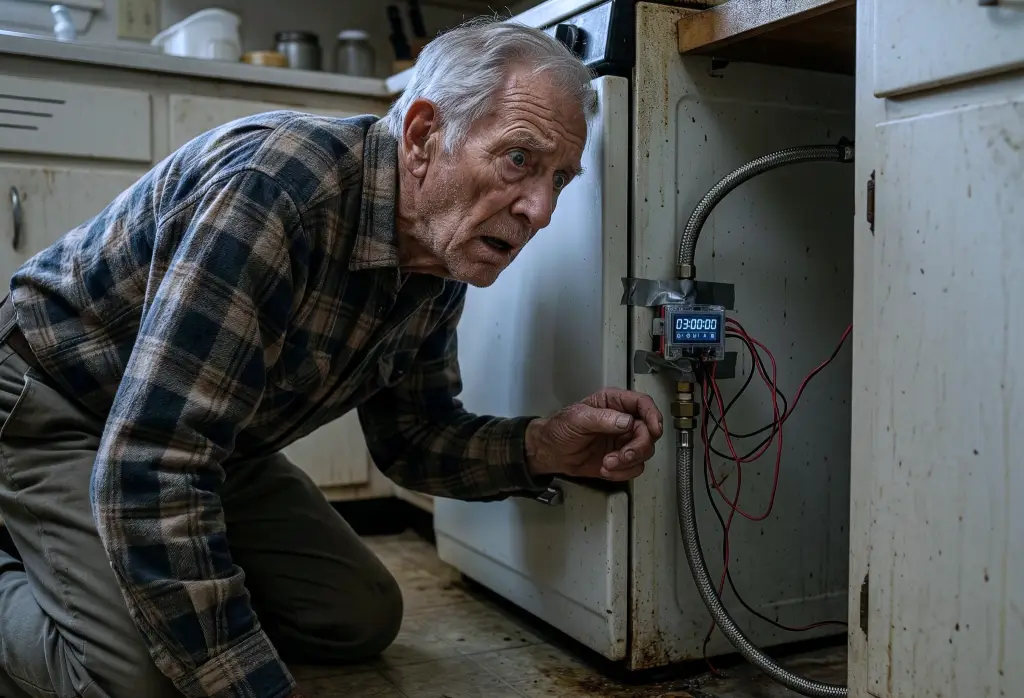
I am eighty-eight years old, living out the twilight of my life in a modest, weather-beaten house on the outer edge of Cleveland, Ohio. I inherited this place from my parents a little over a decade ago. For the past three months, my son, David, has been calling me every single night. Exactly at nine-fifteen. Always with the same chilling question, asking if I am alone.
Yesterday, I made a choice that defied my nature. I lied to him. That single, desperate falsehood ended up saving my life. I am writing this as a stark warning to other parents who, like me, could never fathom that the child they raised might one day become their most lethal threat.
The afternoon began with the mundane rhythm of any other day. I had just returned from the local auto shop where I still turn wrenches part-time. At fifty-eight, I realized that bone-crushing heavy labor was no longer for me, but thirty years later, my hands remain steady. The younger mechanics still appreciate the earned wisdom of an old-timer. I was standing at my kitchen sink, methodically scrubbing grease from a set of ratchets, the smell of dark roast coffee brewing in the background.
Then, my cell phone shattered the quiet.
“Hello?” I answered, wiping my calloused hands on a grease-stained shop rag.
“Dad, it’s me.” David’s voice carried that same flat, hollow cadence it had held for months. It was devoid of warmth, almost entirely stripped of emotion.
“Ah, son, how are you?” I forced a cheerful tone, gripping the edge of the counter. “Everything okay at work?”
“Yeah, everything’s fine,” he replied, clipping his words.
Then came the question. The one that made the hair on my arms stand up.
“Are you alone right now?”
My heart battered against my ribs. For ninety days, I had told the truth. I had always said yes. And every time, without fail, the line would go dead as David hung up. On the rare occasions someone had been over, he had interrogated me with military precision, demanding to know who was there, what they were doing in the house, and exactly how long they planned to stay.
This time, a primal instinct flared to life.
“No, no, I’m not alone,” I answered. My knuckles turned white around the plastic casing of the phone. “Amanda stopped by for coffee.”
The silence radiating from the receiver was absolute, heavy with unsaid things.
“Amanda?” His voice hitched, the carefully maintained flatness fracturing. “The lawyer?” The tension bled through every sharp syllable. “What is she doing there?”
“She came to help me with some papers for the house,” I improvised, my mouth suddenly dry. “You know, that paperwork I never seemed to understand.”
“What papers? What are you talking about?” David pushed, his breathing growing ragged and fast.
“Nothing important, son. Just the deed to the house, some property taxes. Old man stuff,” I said, striving for an easy, casual chuckle. “Why? Do you need something?”
“No,” he snapped, the word biting like a winter wind. “We’ll talk tomorrow.”
The dial tone hummed in my ear. He had hung up without a goodbye.
I stood paralyzed, staring at the blank screen of my phone, a knot of relief and profound dread twisting in my stomach. It was the first time in three months I had broken our grim routine, and David’s volatile reaction unnerved me deeply. I set the phone on the worn formica table and walked to the window. The little house my parents left me is not a mansion. It boasts two small bedrooms, a cramped bathroom, a linoleum-floored kitchen-diner, and a modest living room. But it is my sanctuary, saturated with decades of memories and a lifetime of honest sweat. I never imagined I would have to build a fortress against my own flesh and blood.
David was born when I was twenty-six. His mother, Lucy, and I never married, but we tried to make a home for him until she grew restless. When David was seven, she packed up and moved to Chicago, consumed by her constant traveling for work. I retained full custody. Raising a boy alone was a rugged road, but I gave him every ounce of love I had. David grew up quiet, fiercely intelligent, and highly observant. He earned his degree in business administration and landed a solid position at a corporate insurance firm right here in Cleveland. We maintained a steady, normal relationship—Sunday lunches, holiday dinners, the comfortable rhythm of an adult father and son. There was never any real friction between us.
Until three months ago.
It began as a slow bleed of unsettling details. A coffee mug left on the wrong counter. Documents in my study drawer stacked in a different order. I couldn’t shake the creeping sensation that the air in my home had been disturbed while I was at the shop. Initially, I blamed my aging mind. At eighty-eight, you learn to second-guess your own memory.
Then the nightly calls began. Nine-fifteen. On the dot. I tried pressing David for a reason, but he always deflected, claiming he was simply worried about an old man living by himself.
The tipping point came when I returned home to find my heavy steel toolbox unlatched. My large wrench was entirely missing. I tried to convince myself I had loaned it out, but two days later, the drawer harboring my most vital documents was resting a fraction of an inch open.
I made a choice no father ever wants to make. I decided to spy on my own home. My old friend Ray, who manages a local electronics store, came over quietly and helped me set up two discrete cameras—one observing the living room, the other angled at the front door. He synced the feed directly to my phone.
The first two nights yielded nothing but static shadows.
On the third night, I was jolted awake at three in the morning by a faint shifting of floorboards. I scoured the house, finding nothing but cold air. Come morning, I pulled up the security footage. The blood drained from my face.
At exactly two thirty-seven in the morning, the front door swung open with agonizing slowness. David stepped over the threshold. He used a key I had never given him, moving through the dark with the chilling familiarity of a ghost. He bypassed the living room entirely, marching straight to the drawer holding my personal documents. In the grainy night-vision feed, I watched my son methodically extract my papers, photograph them under the harsh glare of his phone screen, and replace them with surgical precision.
But that was not the worst of it.
David then crept down the hall toward my bedroom. He pushed the door open just enough to slide his face into the gap. He stood there, perfectly still, watching me sleep for a full sixty seconds before evaporating into the night as silently as he had arrived.
The floor felt like it was dropping out from under me. Why was my boy invading my home? What was he searching for?
That afternoon, I called Amanda Vance. She is a sharp, fiercely honest lawyer who had handled my parents’ estate, and the only soul I felt I could trust with this nightmare. We met at a crowded diner miles away from David’s corporate office. I slid my phone across the table and played the video.
Amanda watched the footage in grim silence. When she finally looked up, her eyes were hardened. She told me this was not just trespassing; it was a severe violation of my safety. I recounted the missing wrench, the rearranged drawers, and one detail that had been gnawing at the back of my mind. Four months prior, David had urgently asked to borrow fifty thousand dollars for an emergency investment. I wired him the funds without a second thought. He had always been meticulous with his finances.
Amanda leaned forward, asking if he was searching for anything valuable. I had nothing but my meager pension, my shop wages, and a house that barely held market value. The papers he photographed were my bank statements, the property deed, and my driver’s license. She pressed me on David’s personal life—asking about debts, illicit substances, or toxic influences.
I had no concrete answers. I explained that we had drifted since his divorce from Jessica two years ago. He had become intensely withdrawn. During our Sunday lunches, he would often sit in a fog, occasionally mumbling to himself. Once, I caught him barking furiously into his phone, only for him to brush it off as a difficult client.
Amanda reached across the table, her hand covering mine. Her touch was meant to comfort, but her words sent a violent shiver down my spine. She told me we had to discover what David was plotting. If he had a copy of my key and was hoarding my personal data, he was laying the groundwork for something devastating. She asked if I had a way into his apartment.
The thought felt like a betrayal. But then the image of his hollow eyes watching me sleep flashed in my mind. I confessed that I had an emergency key he gave me years ago. Amanda immediately decided we were going in.
That afternoon, my stomach churning with acid, I stood before David’s third-floor apartment door. Amanda flanked me, her quiet strength anchoring my trembling hands. I slipped the key into the lock, making sure the hallway was deserted.
The apartment was immaculately clean, reflecting the rigid sense of order I had instilled in him. Yet, the air felt heavy, suffocating. Amanda directed my attention to a sleek desk tucked into the corner of the living room. We approached it like it was a live explosive.
Scattered across the polished wood was a financial massacre. Past-due notices, banking statements bleeding red, and aggressive final-warning letters from collection agencies. Amanda quickly tallied the numbers. My son was drowning in over half a million dollars of debt. I felt like a stranger standing in a dead man’s home.
As we sifted through the wreckage, my breath hitched. Partially concealed under a stack of envelopes was a formal Power of Attorney document. It granted David total administrative control over Michael Stafford’s assets. At the bottom rested my signature. It was a crude, desperate forgery.
Amanda’s jaw set as she confirmed that any notary would flag it in a heartbeat. But it was the top drawer of the desk that shattered my world entirely. Nestled in the back was a small, unlabeled glass vial filled with a clear liquid. Lying directly beneath it was a printed medical sheet. It detailed the exact dosages of heavy sedatives required to neutralize an elderly adult.
Amanda’s voice dropped to a terrified whisper, insisting we leave immediately and contact the authorities.
Before I could move, my cell phone vibrated violently against my hip. It was an urgent text message from my neighbor, Helen Carter.








Comments are closed.