
I stood frozen in the center of that freezing room for a very long time, my eyes locked on the grey metal.
“I haven’t touched it,” Terry added, stepping back to give me space. “I just… I thought you needed to see it exactly the way I found it.”
I didn’t even have to think about the combination. I knew the sequence of numbers in my bones before my conscious mind even registered the thought. My wife had always used the exact same four-digit code for every single padlock, PIN, and security measure in her life. It was our oldest grandson’s birthday.
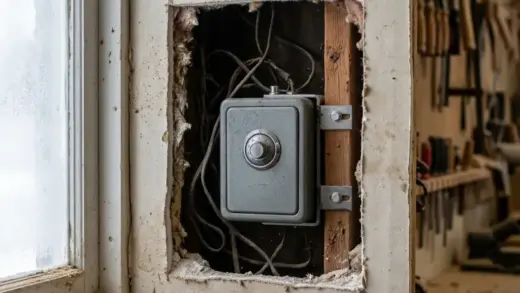
I crouched down on the dust-covered floorboards, reached into the wall cavity, and spun the cold metal dial. The heavy latch disengaged with a sharp, metallic click.
I pulled the box out into the light and opened the lid.
Inside, resting on the bottom, was a small silver USB drive. Beside it lay a compact notebook with a sturdy brown cardboard cover, the exact kind she always used to keep tucked in the front pocket of her woodworking apron. And resting quietly beneath those two items was a thick, sealed paper envelope. My name was written across the front of it in her unmistakable, elegant handwriting.
My knees gave out. I sat down hard on the freezing floor of the workshop, the open box resting in my lap, and I did not move a muscle for what felt like hours. I couldn’t bring myself to tear open the envelope that morning. The weight of it was simply too much.
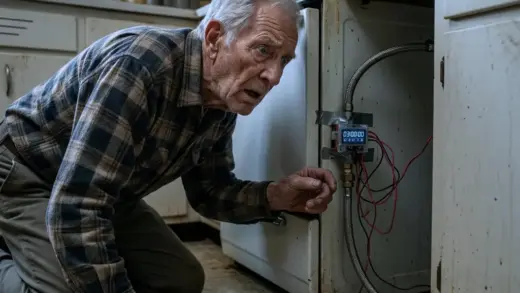
Eventually, I found my voice. I thanked Terry for his honesty. I pulled out my wallet, paid him in full for the weekend’s labor, and quietly asked him to come back and finish the rewiring job the following week.
He looked down at me, his brow furrowed. He asked me if I was alright.
I looked back up at him and told him the absolute truth. I honestly didn’t know yet.
Terry nodded. It was that specific, silent nod that men from the North give when they inherently understand that a situation doesn’t have clean edges or easy answers. He turned around and walked away to his truck without uttering another syllable. I respected him deeply for giving me that quiet exit.
I carried the heavy lockbox across the yard, brought it inside the house, and placed it dead center on the kitchen table. I brewed a pot of dark coffee. Then, I sat down across from the grey metal container, staring at it as though the box itself might start speaking and explain the madness.
Diane had intentionally hidden that box in the walls before she died. She had taken a drill, screwed a metal bracket into a wooden stud with her own two hands, placed her secrets inside, locked it tight, and sealed the drywall back over it. She clearly wanted it to be found eventually. Otherwise, why go through the trouble of leaving anything behind at all? But she absolutely hadn’t wanted it to be stumbled upon casually.
My wife had always been an incredibly careful, methodical woman. She never did a single thing without a damn good reason.
I reached out and opened the cardboard notebook first. Diane’s handwriting was small, perfectly even, the letters packed tightly together across the narrow lines. She had been keeping meticulous notes. They were dated entries, stretching back almost two full years before her heart gave out.
The very first pages were purely observational. Small, nagging things she had noticed but couldn’t quite brush off. A strange discrepancy in our joint investment account. She noted a specific withdrawal—one she certainly hadn’t made, and knew I hadn’t made either—for exactly $8,000. In the bank record, it was vaguely described as a transfer that had been authorized.
She had drawn a thick circle in blue ink around the word authorized and placed a heavy question mark right beside it.
She hadn’t just let it go. She had taken this directly to our financial advisor, a polished man named Clifton Rowe. Clifton had been managing our retirement portfolio for eleven years. We trusted him. According to her neat cursive, Clifton had smiled and assured her it was nothing more than a routine portfolio rebalancing fee. He claimed it had been pre-authorized in our original onboarding contract.
“He showed me a page in the original document,” Diane had written. “I don’t remember signing anything like that. We’ll check my copy.”










Comments are closed.