
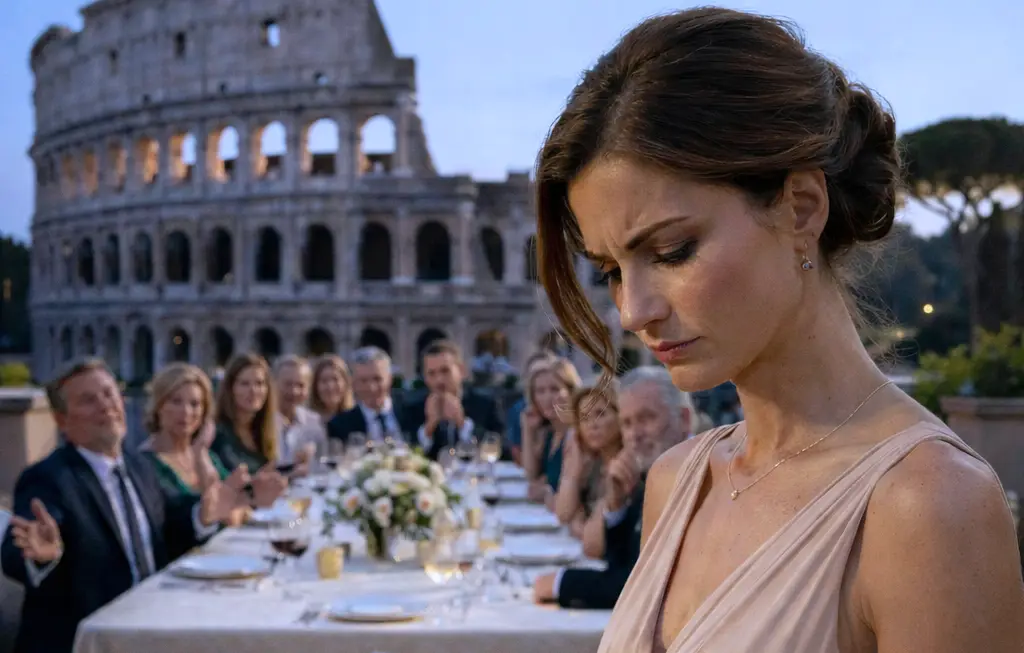
The empty space at the table screamed louder than any shout could have. We were at my mother-in-law’s seventieth birthday dinner in Rome, surrounded by the amber glow of the Eternal City, yet the only thing I could focus on was the void where my chair should have been.
My husband, Sean, let out a light, practiced chuckle. “Oops,” he said, the sound casual, as if he’d just dropped a napkin rather than humiliated his wife. “Guess we miscounted.”
A ripple of laughter moved through the family—soft, cruel, and shared. As their amusement settled, I stood there, feeling the heat rise in my cheeks, but I refused to let my composure crack.
“Seems I’m not family,” I said calmly. I turned on my heel and walked out.
Thirty minutes later, they discovered I had canceled the entire event. The venue, the catering, the wine—everything. I wasn’t there to see it, but I know the moment the realization hit them, their faces turned ghostly white.
“Seems I’m not family.”
I had repeated the words as I walked away, my voice steady despite the absolute earthquake rattling inside my chest. Those words hung in the air of that exclusive Roman restaurant as twelve pairs of eyes stared back at me. Their expressions ranged from feigned shock to poorly concealed satisfaction. Sean’s chuckle—”Oops, guess we miscounted”—still echoed in my ears as I turned my back on the table where there was no chair for me.
The humiliation burned through my veins like acid as I exited the restaurant, stepping out into the cooling Roman evening. But not a single tear fell. Instead, an eerie, glacial calm took over my system. I pulled out my phone and opened the event management app I had built my entire career on. I calculated that I had exactly thirty minutes before they would realize what I was doing.
That was more than enough time to burn it all down.
To understand why I pulled the trigger on that nuclear option, you have to understand the woman I was before I boarded that flight to Italy. My name is Anna Morgan Caldwell. Five years ago, I was just Anna Morgan, the founder of Elite Affairs, Boston’s most sought-after event planning company.
I had built my business from the ground up, scraping by to put myself through business school. I clawed my way into the upper echelons of society by ensuring that every elegant gala, every perfectly executed corporate gathering, and every high-society wedding in Boston had my invisible fingerprints all over it. My reputation for absolute discretion, obsessive attention to detail, and the ability to pull off the impossible made me the go-to planner for the city’s elite.
That was how I met Sean Caldwell.
It was at a charity gala I had organized for the Boston Children’s Hospital. He was tall, possessed perfectly coiffed dark hair, and wore a smile that crinkled the corners of his eyes—the easy, relaxed confidence of a man who had never spent a single second of his life worrying about rent. He was charming in that practiced way of men born into privilege, but there seemed to be something genuine in his interest.
“So, you’re the wizard behind all this?” he had asked, gesturing to the transformed ballroom of the Four Seasons. “My mother has been trying to figure out who to hire for her charity function next month. I think I just found her answer.”
One job led to another, and soon I was regularly planning events for the entire Caldwell clan. The Caldwells were Boston aristocracy, boasting old money that traced its roots back to shipping and railroads. They possessed that particular brand of wealth that felt no need to show off; it was evident in the subtle quality of everything they owned and the effortless way they navigated the world.
Our romance began six months after I started working for his family. Sean pursued me with the same relentless determination he brought to his work at the family’s investment firm. Looking back, the warning signs were flashing neon red, though I chose to wear rose-colored glasses.
There was the way his mother, Eleanor, looked at me—a gaze filled with barely concealed disapproval—when Sean first introduced me as something more than just “the help.” There were the casual, stinging comments about my humble beginnings. There was the genuine surprise in people’s voices when they discovered I was dating a Caldwell.
“You’ve done well for yourself,” Eleanor had said during our first dinner together as a couple. Her smile was tight, never reaching her eyes. “Self-made success is so… American.”
I ignored the jab because I was falling in love with Sean. He seemed different from the rest of them—more open-minded, less obsessed with lineage and status. When he proposed eleven months after our first date, I said yes, shoving down the nagging feeling that I was entering a world that would never truly accept me.
The wedding was, naturally, the social event of the season. I planned much of it myself, unable to trust another planner with the most important day of my life. Eleanor, of course, had opinions about everything. The venue wasn’t traditional enough; the menu was too adventurous; the guest list was missing key society names. I compromised where I could, but I held firm where it mattered.
Sean played the peacemaker, but I noticed he rarely contradicted his mother directly.
After the wedding, the undermining shifted from subtle to systematic. Despite using my company for their events, the Caldwells constantly questioned my decisions, changed plans at the last minute, and took credit for my ideas. At family gatherings, my opinions were solicited only to be immediately dismissed. My background in event planning was treated as a charming little hobby rather than a successful enterprise.
“Anna has such a good eye for these things,” Eleanor would say to her friends, patting my hand with condescending affection. “It’s almost like having a personal party planner in the family.”
Sean never defended me. He would just shrug later and say, “That’s just how Mother is. You shouldn’t take it personally.”
But it was personal. And as the years passed, it only got worse.
The opportunity to plan Eleanor’s seventieth birthday in Rome should have been my crowning achievement. It was designed to be a week-long celebration in the Eternal City, culminating in a dinner at a Michelin-starred restaurant overlooking the Colosseum. I threw myself into creating the perfect event, leveraging every contact I had in the industry.
It was during this planning phase that I discovered the first cracks in the Caldwell façade.
Deposits for venues were delayed. Vendors began calling me, asking about payments. When I mentioned it to Sean, he brushed it off, claiming the family accountant was just being “cautious with international transfers.” But one evening, I saw the statements he had accidentally left open on his laptop.
The numbers were horrifying. Investments gone bad, properties mortgaged to the hilt, lines of credit maxed out. The Caldwell fortune was dwindling fast. Still, I kept planning, even using my own company’s credit line to secure deposits when needed to save face. I told myself it was temporary, that Sean would explain everything once the birthday celebration was behind us.
Then came the morning of our flight to Rome.
Sean was in the shower when his phone pinged on the nightstand. I never checked his phone; I had always respected his privacy. But something—an intuition, a gut feeling—made me look that morning.
The message preview from “V” was clear on the locked screen: Can’t wait to see you in Rome. Have you told her yet?
My fingers moved without conscious thought, unlocking the phone and opening the message thread with Vanessa Hughes, Sean’s college girlfriend. The woman his parents had always adored. The woman they had expected him to marry before he met me.
The messages went back months. Plans made. A future discussed. And yes—a baby. Their baby, due in four months.
I felt the blood drain from my face, but I didn’t scream. I took screenshots, forwarded them to myself, and then deleted the evidence of the transfer from his phone. I packed my bags, plastered a smile on my face, and boarded the flight to Rome with my husband and his family.
Now, standing outside that restaurant in Rome, I made my choice. I wouldn’t confront Sean before the dinner. I would let events unfold. And when they did, I would be ready.
Our flight had landed at Fiumicino Airport just as the golden Italian sunset painted the skyline. I had arranged private transportation for the entire Caldwell entourage: Sean’s parents, Eleanor and Richard; his sister, Melissa, with her husband, Grant; his brother, Thomas, with his wife, Claire; and two sets of aunts and uncles.
A convoy of sleek black Mercedes vans was waiting at the terminal. It should have impressed them. Instead, Eleanor’s first words stepping off the plane were a complaint.
“I thought I’d specified the hotel cars, Anna,” she sniffed, looking at the pristine vehicles. “These seem rather generic.”
I bit my tongue, as I had countless times before. “The hotel had a scheduling issue. These are actually from Lux Transport. They service most of the diplomats in Rome.”
My explanation fell on deaf ears. She was already discussing something with Richard, their heads bent together in that conspiratorial way that always excluded me.
The Hotel de Russie welcomed us with the five-star treatment I had meticulously arranged. Champagne flowed in the private lounge while bellhops whisked away our luggage. I had spent months securing the perfect accommodations, selecting suites with the best views, arranging welcome baskets filled with local Italian delicacies, and planning personalized schedules for each family member.
Eleanor barely glanced at her itinerary before setting it aside on a velvet armchair. “We’ll just play it by ear,” she said, waving away weeks of careful planning. “The family knows Rome quite well.”
Our suite was magnificent—a terrace overlooking the Spanish Steps, fresh flowers in every room, and a bottle of Sean’s favorite Merlot breathing on the sideboard. But the moment we entered, Sean’s phone buzzed. He stepped onto the terrace, speaking in hushed tones.
“Work?” I asked when he returned.
“Just some investment issues,” he replied, refusing to meet my eyes. “Let’s get ready for dinner.”
The welcome dinner I’d planned at a charming trattoria in Trastevere became the first clear sign of my exclusion. Somehow, the seating arrangement shifted moments before we sat down. I found myself at the far end of the table, separated from Sean by his cousin and an aunt.
Throughout the meal, inside jokes flew across the table like tennis balls—stories of previous family trips to Italy from which I’d been absent. When I attempted to join the conversation about the week’s planned activities, Melissa interrupted me.
“Oh, Anna, we’ve actually decided to do some family shopping tomorrow instead of the Vatican tour.”
“Family shopping?” I asked, confused.
“You know,” Eleanor interjected smoothly, swirling her wine. “Just some tradition we have. You’d be bored, dear. Why don’t you use the time to check on the birthday arrangements? That’s your expertise, after all.”











Comments are closed.