
I sat on the edge of the bed, exhaling heavily as I opened the first message from Harper Quinn, one of the few colleagues at Brixell who understood how fragile the company’s internal ecosystem truly was.
Please tell me Graham didn’t actually fire you. Audit prep is collapsing. Clark tried to run your sequence and crashed the reconciliation module. Clients are already asking for you by name.
A second message arrived before I could even formulate a thought.
He told us you abandoned your responsibilities. No one believes him.
I closed my eyes, letting the weight of seven years settle over me—not as exhaustion, but as clarity. Brixell wasn’t broken because I left. It had always been broken. My absence simply made the fractures visible to the naked eye.
A voicemail from HR came next. The tone was stiff, scripted, and sounded almost rehearsed.
— Per protocol, please return all company assets within 72 hours. We will also review your obligations under the confidentiality and restrictive activity clauses.
Translation: Graham was panicking, and he needed bureaucracy to save him. But bureaucracy only works when the system beneath it is stable, and Brixell without me was anything but. I tossed the phone aside, letting it land softly on the duvet. For the first time in nearly a decade, the crisis wasn’t mine to fix.
A knock sounded at the door. When I opened it, Lila stood there holding two espresso cups and wearing a knowing look.
— I figured you might need this, — she said, stepping inside. — Word travels fast. Half the consultants at the retreat are talking about you.
I blinked, confused.
— Me?
She nodded.
— Adrian mentioned you to a few people. The respect in the room shifted instantly. Fiorina, you should have seen it.
I wasn’t sure what startled me more: that Adrian had spoken about me, or that people actually listened. Lila set the cups on the small table.
— You’ve kept Brixell afloat for years. Everyone knows it. Everyone except the man who signs your evaluations.
Her voice softened, losing its professional edge.
— You’re free now. So, what do you want to do next?
The same question Adrian had asked earlier. The same question I’d spent years avoiding. I glanced out the balcony door toward the distant shimmer of the moonlit water.
— I think, — I said slowly, — I want to stop surviving and start choosing.
Lila studied me, then smiled.
— Choose well. Because Graham… he has no idea what’s coming.
As she left, I picked up my phone again. Another email had just arrived, this one from a major client. The subject line read: URGENT – Requesting Continuity with Fiorina Miles.
I stared at it, my heartbeat steady and sure. My story with Brixell wasn’t over. But the next chapter would be written entirely on my terms.
The morning I left Italy, the sky over Naples was washed in pink and gold—too gentle, too peaceful for the message waiting on my phone. It was from the same major client who’d emailed hours earlier. Except this time, the tone carried something heavier than urgency.
We need clarity. Who is handling Fiorina’s portfolio? Our deliverables are now three days behind schedule.
I hadn’t even boarded the plane yet. By the time we took off and the onboard Wi-Fi flickered to life, the consequences of Graham’s impulsive tantrum were already unfolding across my inbox like a slow, inevitable detonation. A thread of internal emails, dozens long, revealed the chaos in real time.
Clark: I can’t complete the audit prep. The reconciliation algorithm keeps producing error codes I don’t recognize.
Operations Lead: That’s because Fiorina customized half the architecture three years ago. No one else knows how to run it.
Finance Director: Clients are escalating. Someone needs to explain what’s happening.
And then, one message from Graham himself, barking orders into the void.
Find Fiorina’s documentation. She must have left something behind. No one is irreplaceable.
I almost laughed out loud at 30,000 feet. Documentation. The system didn’t run on documentation. It ran on insight. Years of refinement. Thousands of micro-adjustments based on instinct and pattern recognition—knowledge you only gained by being in the trenches long enough to see the whole structure breathe. You can’t download that. You earn it.
But the most gutting message came from Harper.
He’s blaming you. Telling leadership you sabotaged the workflow. People are pushing back finally, but it’s ugly.
I stared at the screen, my pulse steady. Surprisingly calm. He was unraveling exactly as Adrian had predicted.
A flight attendant paused beside me.
— Everything all right, ma’am?
I nodded with a polite smile.
— Everything is finally how it should be.
Hours later, when the wheels touched down and the California air greeted me, reality felt different. Heavier, but in a way that grounded rather than suffocated. I wasn’t returning as the woman who once absorbed everyone’s failures. I was someone with options now.
As I rolled my suitcase through arrivals, another call came in from an unknown number. Normally I’d ignore it, but something in my chest said answer.
— Hello?
A familiar voice responded. Low. Strained. Trying and failing to mask panic.
— Fiorina! This is Trevor.
Trevor. The analyst Graham had tried to promote into my role. A good person, but far too green for the weight he’d been given.
— I’m sorry to bother you, — he said, his voice tight. — But I… I don’t know what to do. The audit system keeps breaking. Clients want meetings. Graham is yelling at everyone. He keeps saying you’ll come back.
That last line stunned me. Come back? After nine years of sacrifice, a humiliating dismissal, and insults? No. Those days were gone.
— Trevor, — I said gently. — What you’re dealing with isn’t your fault. But understand this: Graham created this mess. Not you. Not me.
He exhaled shakily, and I could hear the horror and relief mixing in his voice.
— What should I tell them?
I looked out at the horizon, at the first sight of home.
— Tell them, — I said softly, — that Fiorina Miles doesn’t fix mistakes for free anymore.
And here’s the part most people don’t know. The next morning, sunlight filtered through my apartment windows in soft geometric shapes. Warm. Steady. Undeservedly peaceful, considering the corporate wildfire spreading across Brixell DataWorks. I set my suitcase down, plugged in my dead phone, and poured myself a cup of coffee. Before the mug reached my lips, the notifications exploded.
Four voicemails from HR. Seven from Graham. Over a dozen emails marked “URGENT.” I ignored them all and opened the message from Harper instead.
Leadership tried running the audit dry run this morning. The system froze twice. Then the data bridge crashed. Two clients are threatening to pause funding unless you’re reinstated or replaced with someone of equal expertise. Spoiler: that person doesn’t exist.
A second message arrived seconds later.
Graham’s panicking. He’s rewriting the narrative, saying you left without warning.
A humorless laugh escaped me. Nine years of scheduled overnights. Missed breaks. Emergency fixes at dawn. But apparently, I was the unreliable one.
My phone rang again—another unknown number. I let it go to voicemail, expecting another HR script. But the transcription preview froze me mid-sip.
This is the Brixell Board. We need to discuss recent events.
The Board. They never contacted anyone below VP level. The fact they reached out to me directly told me everything: panic wasn’t limited to Graham anymore. The system collapse was now a full-blown leadership crisis.
Before I could process it, the phone rang again. This time, a number I did recognize. Adrian.
I answered immediately.
— Back in the States already?
His voice held that effortless calm, the kind that made chaos sound like an optional inconvenience.
— Just landed yesterday. I imagine your inbox looks entertaining.
— That’s one word for it.
He chuckled.
— I spoke to two of Brixell’s former clients this morning. Both mentioned you. And both expressed concern about the instability since your unexpected departure.
“Unexpected.” The way corporate diplomacy rewrites history never ceased to amaze me.
— I’m not involved anymore, — I said. — They’ll have to work with whoever Graham chose.
— That’s the problem, — Adrian replied. — They don’t want whoever Graham chose. They want continuity. They want competence. They want you.
I inhaled slowly.
— I’m not breaking any contracts. I’m not soliciting anyone.
— You don’t need to, — he said. — When leadership fails, clients follow stability. And from what I hear, you’re the only stable variable Brixell ever had.
His words weren’t flattery. They were confirmation. A pause stretched between us.
— Fiorina, — he continued, his voice lower now. — I’d like to meet again. There are opportunities opening up. Ones that align with your level. Not the level they kept you trapped in.
A knock at my door interrupted him. One sharp, impatient rap. I froze. Adrian heard it.
— Expecting someone?
— No.
Another knock. Harder this time. My pulse steadied. Not fear. But something colder. Controlled.
— I should call you back, — I murmured.
— Be careful, — he said softly.
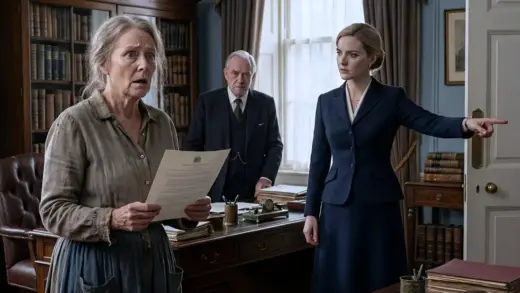
When I opened the door, I wasn’t surprised. Standing there, face flushed with desperation, jaw tight with anger, was a man who couldn’t hide the ruin closing in on him. Graham Turner.
And this time, I wasn’t the one who felt small.










Comments are closed.