
— Happy.
Eva said the word again, testing its weight, her voice growing slightly louder as if she were tasting the very texture of the syllables. Then, with deliberate precision, she pointed a finger at Noah.
— Happy.
She turned her finger toward her parents.
— Happy.
Finally, she pressed her hand against her own chest.
— Happy.
Sarah’s legs gave way, and she collapsed into Henry’s arms, her body shaking with heavy, release-filled sobs. Seven years of absolute silence had just been shattered by one perfect word.
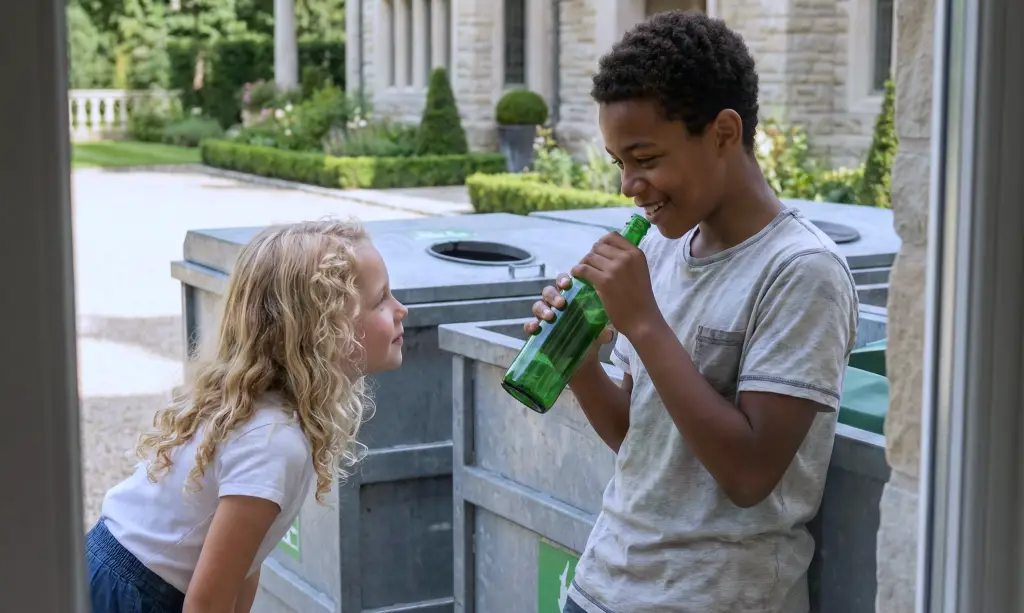
The high-definition security cameras had captured every second of the interaction, yet nothing could have steeled Henry Whitaker for the image flickering on his monitor. There was his seven-year-old daughter, Eva—a child who had never uttered a sound in her life—sitting casually on the mansion’s rear steps beside the industrial garbage bins. And sitting right next to her was a teenage boy, African American, dressed in worn but clean clothing; a stranger who had absolutely no business being on the Whitaker estate.
Henry’s finger hovered violently over the panic button. One press would summon the private security team in seconds. But he froze. A detail on the screen made his blood run cold, then hot. Eva was smiling.
It wasn’t the polite, mechanical grimace she offered her expensive therapists. It wasn’t the sorrowful, reassuring half-smile she gave her mother to ease Sarah’s worry. This was genuine, unadulterated joy, breaking across her face like a sudden sunrise.
And then… Henry had to rewind the footage to confirm his own sanity. Eva’s mouth moved. It wasn’t a random twitch. It wasn’t like the thousand times before when doctors had watched with bated breath, hoping for a miracle. She was deliberately forming a word. One perfect, impossible word.
The boy hadn’t touched her. He hadn’t bribed her with toys or candy. He hadn’t utilized any of the complex cognitive exercises that the $500-per-hour specialists swore by. He had simply been sitting there, sharing a humble peanut butter sandwich, talking to her as if she were just another kid on the block.
Sarah, standing behind Henry now, had her hand clamped over her mouth, tears flowing freely down her cheeks.
— Did she just… did our baby just… she spoke? — Henry whispered, his voice cracking under the strain.
After seven long years of silence, she had spoken to a stranger, a homeless boy rummaging through their trash. But to truly understand the magnitude of this moment, we must rewind to where the cracks in their hope began. Three months prior, Henry Whitaker stood in the center of his daughter’s state-of-the-art therapy room, watching yet another renowned specialist pack away her equipment in defeat.
Dr. Morrison, touted as the country’s leading childhood speech pathologist, could barely conceal her professional frustration.
— Mr. Whitaker, I have run every conceivable test. Eva’s vocal cords are flawless. Her hearing is actually above average. The brain scans indicate completely normal activity in all language centers. There is absolutely no physiological reason why she cannot speak.
— Then why doesn’t she? — Henry’s voice was heavy with seven years of accumulated exhaustion.
— Sometimes, — Dr. Morrison sighed, — sometimes children make a choice, whether conscious or unconscious. Eva has chosen silence, and I simply do not know why.
That evening Henry found his wife, Sarah, in Eva’s bedroom, reading a bedtime story to their silent child. Eva’s bright blue eyes tracked every syllable, her small hands moving fluidly to sign responses in the complex sign language she had mastered. She understood everything. She could communicate via writing, signing, and a specialized iPad application. But her voice—the one thing her parents would trade their fortune to hear—remained locked inside a fortress of her own making.
— Sometimes I wonder if she is punishing us, — Sarah whispered into the dark hallway after Eva had drifted off.
— For what? — Henry asked. — We have given her everything.
— Maybe that is the problem. Maybe we have given her everything except what she actually needs.
They had no idea that a seemingly trivial oversight would soon change the course of their lives. The next morning began with the usual rigid precision. Eva awoke at exactly 7:00 AM, dressed herself in an outfit pre-selected by a styling consultant, ate an organic breakfast prepared by the private chef, and commenced her homeschooling with Mrs. Peterson. She completed every assignment with flawless accuracy, her written responses displaying an intellect far beyond her years, yet not a single sound passed her lips.
Henry watched from his home office, his heart fracturing a little more with each passing day. His daughter was like a ghost in her own existence—present but not fully there, visible but not truly seen. That was when he heard it: a distinct crash coming from the rear of the mansion.
The estate’s garbage collection was contractually handled by a discreet private service that arrived at 4:00 AM, ensuring the Whitakers never had to see, smell, or think about their own refuse. But on this specific Tuesday morning, someone was definitely digging through their bins. Henry snatched his phone to alert security, but his hand stopped mid-motion.
Through the window, he spotted the intruder. It was a teenage boy, perhaps fifteen or sixteen years old, methodically sorting through their recycling. He wasn’t making a mess. On the contrary, he was organizing the chaos, pulling out aluminum cans and glass bottles with practiced efficiency.
The boy was rail-thin, his clothes worn threadbare but scrupulously clean, his hair styled in neat twists despite the obvious poverty that clung to him. He handled each discarded item with a strange reverence, as if even garbage possessed dignity. And he was humming—a melody Henry didn’t recognize, but one that carried a haunting beauty.
— Security can handle this, — Henry muttered, reaching for his phone again.
But then, Eva appeared in the backyard.
Henry’s heart skipped a beat. His daughter never went outside unaccompanied. She was supposed to be in the middle of her mathematics lesson. Yet there she was, standing statuesque, observing the boy with an expression Henry had never witnessed before. It was pure curiosity. The boy looked up and locked eyes with her. Henry braced himself, expecting the intruder to bolt.
Instead, the teenager smiled—the warmest, most genuine expression Henry had seen in years.
— Hey there, little one, — the boy said gently. — Didn’t mean to make noise. Just collecting recyclables. Saving the planet one bottle at a time.
Eva tilted her head to the side, studying him as if he were a complex puzzle she was determined to solve.
— I’m Noah, — the boy continued, treating a one-sided conversation as the most normal thing in the world. — What’s your name?
Eva, naturally, said nothing. But instead of the uncomfortable silence that usually followed when adults realized she wouldn’t respond, Noah simply nodded.
— That’s cool. You don’t have to talk. I talk enough for ten people, my mama always said. God rest her soul.
Eva sat down on the back steps, her eyes fixed on Noah as he worked. He kept up a steady stream of chatter, sharing stories about the neighborhood, his school, and his little sister who was staying with an aunt while he “figured things out.”
— You know what I love about bottles? — Noah asked, lifting a green glass bottle to catch the morning sun. — They sing. Listen.
He blew across the lip of the bottle, producing a low, resonant note.
— Every bottle has its own voice. This one is a baritone. The clear ones? They’re usually sopranos. I’ve been reading about this at the library—acoustics. It’s amazing how sound travels, how it fills the empty spaces. That’s what I want to do one day. Be a sound engineer. Build places where people can really hear each other.
Eva’s eyes widened. For the first time in years, Henry saw a spark of genuine interest animate his daughter’s features.
— Wanna try? — Noah offered, holding out a small bottle.
Eva glanced back at the house, as if seeking permission from the universe itself. Then, she reached out, took the bottle, and held it to her lips. No sound emerged, but she mimed the action of blowing, her cheeks puffing out in a comical fashion.
Noah laughed—not at her, but with her.
— That’s the spirit! You’re a natural bottle musician.
For twenty minutes, Henry watched them. Noah never asked why she didn’t speak. He never looked at her with pity or frustration. He treated her like a normal kid who simply preferred quiet. When Noah finally stood to leave, hoisting his bag of recyclables, Eva did something unprecedented. She waved. Not the stiff, mechanical wave taught in therapy, but an enthusiastic, whole-arm wave that screamed, “Please come back.”
— Same time Thursday? — Noah asked. — That’s recycling day for this whole block. Prime bottle hunting time.
Eva nodded so vigorously her blonde curls bounced. But that was the moment reality crashed back in.
Mrs. Peterson, Eva’s tutor, appeared in the doorway, her face twisted with disapproval.
— Eva! You are supposed to be in lessons! And you… — she glared at Noah with undisguised disdain. — You are trespassing. I am calling the police immediately.
— No! — Henry surprised himself by shouting as he rushed out the back door. — No, it’s fine. He is allowed.
Mrs. Peterson looked scandalized.
— Mr. Whitaker, this boy is—
— Leaving, — Noah said quietly, shouldering his heavy bag. — Sorry for the trouble, sir. Won’t happen again.









Comments are closed.