
As the afternoon wore on and the mother elephant’s condition stabilized, the rescue team began preparing for the next challenge: ensuring that both elephants could safely return to their family herd. Elephants separated from their social groups faced numerous survival challenges, and the mother’s injuries would make independent survival extremely difficult until her leg healed properly.
Using radio communication with other research teams in the area, Dr. Wanjiku was able to locate the elephant’s extended family group approximately five kilometers away. The herd had remained in the general area, apparently searching for the missing mother and calf. This behavior provided additional evidence of the complex social structures that made elephant families among the most tightly bonded animal societies in the world.
The reunion with the extended family required careful coordination to prevent the herd from becoming defensive when they encountered the humans who had been working with the injured elephants. Bob’s role became even more crucial during this phase, as his established relationship with the baby elephant helped demonstrate to the approaching herd members that the human presence was non-threatening.
When the elephant family finally arrived at the clearing, the emotional intensity of the reunion was overwhelming. Adult elephants surrounded the injured mother, touching her with their trunks in gestures that Bob recognized as both greeting and medical assessment. Several elephants examined the baby calf thoroughly, as if ensuring that it had not been harmed during its extended separation from the family.
But perhaps the most touching moment came when the eldest female of the herd, the matriarch who served as the family’s leader and decision-maker, approached Bob directly. She extended her trunk toward him in what elephant behavior specialists recognize as an investigative gesture, carefully scenting him and apparently assessing his intentions. After several minutes of this examination, the matriarch stepped back and emitted a low rumbling vocalization that Bob had never heard before in his years of elephant research.
Dr. Wanjiku, who had far more experience with elephant vocalizations, later explained that this was a sound associated with acceptance and gratitude—a recognition that Bob had played a positive role in the family’s welfare.
As the sun began to set over the Kenyan wilderness, painting the sky in vibrant hues of orange and purple, the rescue operation entered its final phase. The mother elephant was stable enough to travel slowly with her family, though her recovery would take many weeks. The Kenya Wildlife Service team would monitor the family’s progress and provide additional medical support as needed.
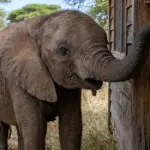
But the baby elephant that had started this extraordinary day by knocking on Bob’s door was not quite finished communicating with the human who had answered its call for help. As the elephant family began to move away from the clearing, the calf separated itself from the group one final time and approached Bob.
What happened next would become the most treasured memory of Bob’s career as a wildlife veterinarian. The baby elephant extended its trunk and gently touched Bob’s face—the same greeting gesture it had used that morning, but with an entirely different meaning. This time, Bob understood. It was a farewell.
But as the baby elephant turned to rejoin its family, it paused and looked back at Bob with an expression that seemed to convey understanding of a depth he had never believed possible in animal-human communication. In that moment, Bob felt that he was being seen and recognized, not just as a human, but as an individual who had responded to a specific request for help from another intelligent being.
The implications of the day’s events would occupy Bob’s thoughts for years to come. The baby elephant had demonstrated problem-solving abilities, memory, planning, and interspecies communication skills that challenged conventional understanding of animal intelligence. It had recognized a crisis beyond its own capabilities and sought out the specific human most likely to be able to provide effective assistance.
But beyond the scientific implications, Bob had witnessed something that spoke to the fundamental connections that could exist between different species when they encountered each other with mutual respect and understanding. The baby elephant had trusted him with the life of its mother, and that trust had been vindicated.
As Bob walked back through the eucalyptus forest toward his research station that evening, he reflected on the journey that had brought him from his comfortable veterinary practice in Colorado to this life among Africa’s most magnificent creatures. His ex-wife, Sarah, had been right that his passion for wildlife had consumed his attention and energy in ways that made him unavailable for human relationships. But she had been wrong about the value of that passion.
What Bob had experienced today was not just another wildlife rescue operation. It was proof that the emotional and intellectual connections he had always sensed with animals were real and profound. The baby elephant’s behavior had demonstrated that the boundary between human and animal consciousness was far less distinct than most people believed.
Standing on the porch of his research station as darkness settled over the African savannah, Bob could hear the distant sounds of the elephant family moving through the forest. The crisis that had begun with urgent knocking on his door that morning had ended with the restoration of a family bond and the beginning of a new understanding of the remarkable creatures he had dedicated his life to protecting.
The baby elephant had knocked on his door seeking help for its trapped mother, but in the process, it had opened a door for Bob to a deeper appreciation of the intelligence, emotion, and social complexity that made elephants among the most extraordinary animals on earth.
As Bob settled down to document the day’s events in his research journal, he realized that the knocking sound that had awakened him that morning would forever hold a special meaning. It had been the sound of one intelligent being reaching out to another across the species barrier, asking for help in a moment of desperate need.
Bob Mitchell, a middle-aged veterinarian from Colorado who had found his true calling in the wilds of Kenya, had been privileged to answer that call. He had witnessed the profound gratitude of creatures whose emotional lives rivaled those of any human family.
The conservation challenges facing Africa’s elephant populations remained as daunting as ever. Poaching, habitat loss, and human-wildlife conflict continued to threaten the survival of these magnificent animals. But Bob’s experience that day had reinforced his commitment to protecting elephants not just as an important species, but as individual beings capable of forming meaningful relationships with humans who approached them with respect and understanding.
In the years that followed, Bob would continue to encounter the elephant family he had helped rescue that day. The mother’s leg healed completely, leaving only a slight limp as evidence of her ordeal. The baby grew into a strong, young elephant that always seemed to recognize Bob when their paths crossed, approaching him with the same gentle trunk touch that had marked their first meeting.
And sometimes, late at night, when the sounds of the African wilderness provided the soundtrack for his dreams, Bob would remember the urgent knocking that had awakened him on that remarkable morning. He would feel grateful that he had been in exactly the right place at exactly the right time to answer the call of a baby elephant in desperate need of human help.
The story of the baby elephant that wouldn’t stop knocking became more than just another wildlife rescue tale. It became a reminder that the boundaries between species were less significant than the connections that could form between any two intelligent beings when they encountered each other with openness, respect, and a willingness to help when help was needed.
Bob Mitchell had traveled halfway around the world to find his life’s purpose among Africa’s elephants. And on one extraordinary morning, an elephant had traveled two kilometers through the forest to find the one human who could save its mother’s life. In that mutual reaching across species boundaries, both had discovered something profound about the nature of intelligence, compassion, and the remarkable connections possible in our shared world.











Comments are closed.