
Bob had read about the strong social bonds within elephant family structures, but witnessing this interaction provided him with insights that no scientific paper could convey. This was not simply instinctive maternal behavior. It was conscious emotional support being provided by a creature experiencing extreme physical trauma to another creature experiencing extreme psychological distress.
During one particularly touching moment, the baby elephant became agitated and began pacing around the edge of the pit, apparently frustrated by its inability to reach its mother more effectively. The trapped elephant immediately began vocalizing in a pattern that Bob had previously associated with calming behavior.
Within minutes, the calf settled down and resumed its patient vigil. The mother elephant was actively managing her baby’s emotional state even while trapped and injured. This level of cognitive sophistication and emotional intelligence challenged Bob’s understanding of the boundaries between human and animal consciousness.
As the morning progressed, Bob began to piece together how the baby elephant had known to seek him out specifically. One month earlier, he had been part of a team that had successfully rescued a young elephant that had become entangled in old fencing wire left behind by previous human activity in the area. That rescue had taken place only a few hundred meters from where he now stood, and it had been witnessed by several members of the local elephant population.
Elephants were known for their exceptional memory abilities, but this baby elephant had somehow connected that previous rescue operation with Bob’s presence and capabilities. It had remembered seeing humans successfully help an elephant in distress, identified Bob as one of those humans, and applied that knowledge to its current crisis.
The implications were staggering. This elephant had demonstrated not only memory and pattern recognition, but also planning, reasoning, and the ability to seek help from a different species based on previously observed successful outcomes.
As Bob continued to document the mother elephant’s condition and monitor her vital signs as best he could from the edge of the pit, he realized that this rescue operation would be about far more than saving one trapped animal. This was a profound reminder of the cognitive and emotional sophistication that made elephants among the most remarkable creatures on earth. The baby elephant had not simply stumbled upon a human who might be able to help; it had deliberately sought out the specific human most likely to understand the situation.
The sound of approaching vehicles in the distance indicated that the Kenya Wildlife Service rescue team was finally arriving. Bob felt a surge of relief mixed with anticipation. The next few hours would determine whether this remarkable display of interspecies communication and elephant intelligence would result in a successful rescue or become a tragic reminder of the ongoing threats faced by Africa’s wildlife populations.
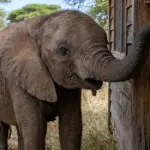
As the rescue team’s vehicles grew closer, the baby elephant positioned itself near Bob and extended its trunk to touch his hand one more time. Bob understood that this gesture represented something unprecedented in his experience as a wildlife veterinarian. It was a conscious expression of trust and gratitude from one species to another based on reasoning, planning, and hope, rather than simple instinct.
The rumble of heavy machinery approaching through the forest marked the beginning of the most complex and emotionally charged wildlife rescue operation Bob Mitchell had ever witnessed. The Kenya Wildlife Service team arrived with equipment that seemed almost impossible to transport through the dense eucalyptus forest. They brought a mobile crane mounted on a specialized all-terrain vehicle, portable hydraulic lifting equipment, and enough veterinary supplies to establish a temporary field hospital.
Team leader Dr. James Wanjiku, a veteran wildlife veterinarian with over twenty years of experience in large animal rescue operations, quickly assessed the situation. He began coordinating what would become a grueling six-hour battle against time, physics, and the challenges of working with a massive, injured, and understandably frightened animal.
The baby elephant, which had maintained its vigil at the pit’s edge throughout the morning, initially showed signs of alarm as the human activity around its mother’s location intensified. But in a display of intelligence that continued to astound Bob, the calf seemed to understand that these new humans were there to help rather than harm.
When the rescue team began setting up their equipment, the baby elephant positioned itself where it could observe the activity while staying out of the way of the machinery. It was as if the young creature understood that its own safety was essential to its mother’s well-being and that interfering with the rescue efforts would be counterproductive.
Dr. Wanjiku’s first priority was stabilizing the mother elephant’s medical condition before attempting any physical extraction. Using a dart rifle loaded with a carefully calculated dose of sedative, he was able to reduce her stress levels and pain response while keeping her conscious enough to assist with the rescue efforts. This delicate balance was crucial. Too much sedation could compromise her breathing and circulation, while too little would mean that the trauma of being lifted from the pit could cause dangerous shock.
The technical challenges of the rescue operation were immense. The pit’s walls were too unstable to support heavy machinery, which meant that all lifting equipment had to be positioned well back from the edge. This required the use of extension cables and rigging systems that complicated every aspect of the extraction process.
More challenging still was the fact that the elephant’s injuries meant that traditional lifting techniques could not be used. Her broken leg made it impossible to support her weight in the normal fashion, requiring the team to design a custom sling system that could distribute her massive weight without causing additional trauma.
Throughout the entire operation, Bob found himself serving as an intermediary between the team and the baby elephant. The calf had clearly bonded with Bob during their morning journey through the forest, and it seemed to trust him in a way that it did not yet trust the other humans involved in the rescue.
When the baby elephant showed signs of distress as the machinery was positioned around the pit, Bob was able to calm it using gentle vocalizations and non-threatening body language. When the calf appeared to want to approach its mother but was prevented by the activity, Bob served as a communication bridge, helping the young elephant understand that the temporary separation was necessary.
The extraction itself was a testament to both human engineering capabilities and animal resilience. The custom sling system designed by the rescue team distributed the mother elephant’s weight across her entire torso, avoiding pressure on her injured leg while providing enough support to lift her massive form from the pit.
As the crane began to lift, both Bob and the rescue team held their breath. An adult elephant’s weight at this angle created enormous stress on both the lifting equipment and the animal herself. The slightest miscalculation could result in equipment failure or additional injury to an already traumatized creature.
But the elephant herself seemed to understand what was happening. Despite her sedation, she positioned her body to work with the lifting system rather than against it. As she rose from the pit, she used her good legs to steady herself and her trunk to maintain balance. It was as if she was actively participating in her own rescue.
The moment when the mother elephant’s feet touched solid ground outside the pit was one of the most emotionally powerful experiences of Bob’s professional career. The immediate reunion between mother and calf demonstrated the depth of elephant emotional bonds in a way that no scientific study could capture.
The baby elephant rushed to its mother’s side, using its trunk to touch and examine every part of her body as if conducting its own medical assessment. The mother elephant, despite her weakened condition and obvious pain, immediately began the soft rumbling vocalizations that Bob had learned to recognize as maternal reassurance behaviors.
But the rescue operation was far from over. The mother elephant’s injuries required immediate medical attention, and her condition after hours of trauma and stress needed careful monitoring. Dr. Wanjiku’s team established their temporary field hospital right there in the forest clearing, recognizing that moving the elephant in her current condition would create additional risks.
The treatment of her broken leg required a surgical procedure that pushed the boundaries of veterinary field medicine. Working without the controlled environment of a proper veterinary facility, the team had to stabilize the fracture using techniques typically reserved for much smaller animals, scaled up to accommodate an elephant’s massive bone structure.
Throughout the medical procedures, the baby elephant maintained its position near its mother’s head, providing what could only be described as emotional support. The mother elephant’s stress levels, as monitored by the veterinary team’s equipment, remained significantly lower when her calf was within reach than when rescue activities required temporary separations.
Bob found himself documenting not just the medical aspects of the rescue, but also the behavioral interactions that demonstrated the sophisticated emotional lives of these remarkable animals. The way the baby elephant seemed to understand that its mother needed quiet during certain procedures; the way the mother elephant would use her trunk to gently guide her calf away from potentially dangerous equipment while never losing physical contact entirely.
Most remarkably, both elephants seemed to understand that the humans involved in the rescue were there to help rather than harm. Bob had seen elephants react to human presence with everything from curiosity to outright aggression, but he had never witnessed the kind of cooperative trust that both mother and calf displayed throughout the rescue operation.










Comments are closed.