
Sarah had been clear in her reasoning. She needed a husband who was present, not one whose heart and mind were constantly occupied with thoughts of animals that lived thousands of miles away from their suburban Denver home.
She hadn’t been wrong. Even during their ten-year marriage, Bob had spent his free time devouring wildlife journals, watching documentaries about African conservation efforts, and volunteering with local wildlife rehabilitation centers.
When the opportunity had arisen to join a long-term research project focused on elephant behavior and conservation in Kenya, Sarah had given him an ultimatum that he ultimately couldn’t meet. The irony was not lost on him that the very passion that had cost him his marriage had led him to this exact moment. He was standing face to face with a baby elephant that seemed to need his help more than any domestic animal he had ever treated in his Denver practice.
Bob made his decision with the same certainty that had driven him to leave everything behind and travel halfway around the world to pursue his true calling. He walked back into his research station, grabbed his field medical kit, several water bottles, and a handheld radio for emergency communication with the main conservation headquarters.
“All right, little one,” he said, adjusting the brim of his Denver Broncos cap against the strengthening morning sun as he rejoined the waiting animal. “Show me what you need me to see.”
The baby elephant’s reaction was immediate and unmistakable. Its entire demeanor shifted from patient waiting to purposeful action. It turned and began walking toward the dense eucalyptus forest that bordered the research station, pausing every few meters to ensure that Bob was still following.
As they walked, Bob observed the elephant’s gait and behavior with his trained veterinarian’s eye. The calf moved with the slightly awkward but determined stride typical of young elephants, but there was a palpable urgency to its pace that suggested it was operating on a timeline that had nothing to do with typical grazing patterns.
The forest they entered was part of a larger ecosystem that Bob had been studying for years. The eucalyptus trees, originally introduced to the area decades earlier, had created a unique microenvironment that supported a diverse range of wildlife.
The thick canopy filtered the morning sunlight into dappled patterns that danced across the forest floor as a gentle breeze stirred the leaves overhead. Bob had walked these paths many times during his years at the research station, but never under circumstances like these. Usually, his forest expeditions were planned, methodical affairs designed to collect specific data or monitor known elephant populations. This felt entirely different—more like an emergency response than a research mission.
The elephant maintained its steady pace for nearly twenty minutes, leading Bob deeper into the forest than he typically ventured on foot. The underbrush grew thicker, and the paths became less defined. Bob found himself using his radio to mark GPS coordinates every few minutes, ensuring that he could find his way back to the research station if necessary.
As they walked, the morning sounds of the forest began to change. The typical bird songs and insect noises that characterized this ecosystem were gradually replaced by something else. It was a low, mournful sound that Bob couldn’t immediately identify, but that made his professional instincts go on high alert.
The baby elephant’s pace quickened as the sound grew louder. What had started as barely audible became more distinct with each step they took deeper into the forest. Bob realized with a sinking heart that he was hearing a sound that every wildlife veterinarian dreaded: the distressed vocalizations of an animal in serious trouble.
Twenty meters ahead, the baby elephant stopped at the edge of a small clearing and turned to look back at Bob with an expression that seemed to say, This is why I came to find you. Bob approached the clearing cautiously, his medical kit ready and his mind preparing for whatever emergency he was about to encounter. But nothing in his extensive training and experience had prepared him for what he found in that quiet corner of the Kenyan wilderness.
The clearing opened before Bob like a scene from a nightmare. What he discovered there would stay with him for the rest of his life, yet simultaneously restore his faith in the emotional intelligence and social bonds that made elephants among the most remarkable creatures on earth.
At the center of the small clearing, partially hidden by dense undergrowth and scattered fallen eucalyptus branches, was a deep pit approximately three meters across and nearly three meters deep. The steep earthen walls of the pit were reinforced with carefully placed stones—the unmistakable signature of a trap designed to capture large wildlife.
But this trap had not captured its intended victim cleanly. Instead, it had become a prison for what Bob immediately recognized as an adult female elephant—the baby’s mother.
The magnificent creature lay at the bottom of the pit, her massive form contorted in a position that spoke of hours, or perhaps days, of desperate struggle to escape. Her left front leg was bent at an unnatural angle, clearly suffering a fracture from her fall into the trap.
Marks on the earthen walls indicated where she had repeatedly attempted to dig her way out. Her powerful tusks and trunk had worked frantically against the hardened soil until exhaustion had finally overcome her efforts.
But she was still alive. The low, mournful sounds that Bob had been hearing during their walk through the forest were coming from her. Her vocalizations were unlike anything in his extensive experience with elephant communications.
These were not the trumpeting calls of alarm or the rumbling social communications he had documented in his research. These were the sounds of an intelligent social creature experiencing physical pain and emotional distress.
The baby elephant that had led Bob to this scene immediately rushed to the edge of the pit and began what could only be described as a conversation with its trapped mother. The adult elephant’s response was immediate and heart-wrenching. Despite her obvious pain and weakened condition, she lifted her trunk toward her calf and emitted a series of soft rumbling sounds that Bob recognized as the reassuring vocalizations mothers used to comfort their young.
Bob knelt at the edge of the pit and assessed the situation with the cold professionalism that had served him throughout his career. The mother elephant had been trapped for at least forty-eight hours based on the evidence around the pit. She was severely dehydrated, weakened from her struggles to escape, and suffering from what appeared to be a compound fracture of her left front leg.
More concerning was the depth of the pit and the construction of its walls. This was not a hastily dug hole. It was a sophisticated snare that had been carefully planned and executed. The walls were too steep and too deep for even a healthy adult elephant to escape without assistance. The fact that it had been camouflaged with branches and vegetation indicated that whoever had constructed it possessed detailed knowledge of local elephant migration patterns.
Bob’s mind raced through possible rescue scenarios, each more challenging than the last. An adult female elephant could weigh between four and six thousand kilograms. Even with mechanical assistance, extracting such a massive creature from a three-meter-deep pit would require equipment and expertise far beyond what he possessed at his remote research station.
But as he watched the interaction between mother and calf, Bob witnessed something that transformed his understanding of elephant intelligence. The baby elephant was not simply staying near its trapped mother out of instinct or confusion. It was exhibiting complex problem-solving behavior that demonstrated a level of cognitive sophistication that even Bob found remarkable.
The calf had clearly been attempting its own rescue efforts. The area around the pit was marked with small trenches where the baby elephant had been using its trunk to dig, apparently trying to create a ramp or pathway that might allow its mother to escape. The effort was futile—a baby elephant lacked the size and strength necessary for such a massive undertaking—but the intention was unmistakable.
More impressive still was the evidence that the calf had been leaving the trapped mother to search for help. Bob found water-soaked vegetation near the pit that the baby elephant had apparently been bringing to its mother in an attempt to provide hydration. Small piles of fresh grass and leaves indicated that the calf had also been trying to provide food.
And then there was the most remarkable evidence of all: the trail that led from the pit directly to Bob’s research station. The baby elephant had not wandered randomly through the forest until it happened upon human assistance. It had deliberately traveled the two kilometers from this clearing to Bob’s door because it somehow understood that humans possessed the tools and capabilities necessary to rescue its mother.
Bob had read studies about elephant memory and problem-solving abilities, but witnessing this level of reasoning and planning firsthand was profoundly moving. This baby elephant had assessed its mother’s situation, attempted its own rescue efforts, recognized the limitations of its own capabilities, and then sought out the specific human in the area most likely to be able to provide effective assistance.
The mother elephant’s condition was deteriorating rapidly. Bob could see that her breathing was labored and her responses to her calf’s vocalizations were becoming weaker. Time was running out, and any rescue attempt would need to be mobilized quickly.
Bob activated his emergency radio and contacted the Kenya Wildlife Service headquarters, requesting immediate assistance for a high-priority elephant rescue operation.
The response was swift and professional. A team would be dispatched immediately with the heavy machinery and veterinary supplies necessary for such an operation. However, the logistics of transporting a mobile crane and medical equipment to this remote forest location meant that help would not arrive for at least six hours.
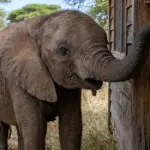
As Bob concluded his radio communication, he became aware that the baby elephant was watching him intently. When he ended the call, the calf approached him and gently touched his hand with its trunk—the same gesture it had used at his research station that morning. But this time, Bob understood the meaning differently. This was not a greeting or a request for attention. It was gratitude.
Somehow, this remarkable young creature understood that Bob had taken action to help its mother. The baby elephant couldn’t understand the specifics of radio frequencies or rescue logistics, but it recognized that Bob’s behavior indicated a commitment to providing assistance.
Over the next hour, as they waited for the rescue team to arrive, Bob observed one of the most touching displays of familial devotion he had ever witnessed in the animal kingdom. The baby elephant maintained a constant vigil at the edge of the pit, regularly extending its trunk down toward its mother in a gesture that served both to provide physical comfort and to maintain an emotional connection.
The mother elephant, despite her weakening condition, consistently responded to her calf’s attention. She would lift her trunk to touch her baby whenever possible, and her vocalizations took on a different quality when her calf was within reach. They became softer, more reassuring, almost as if she were trying to comfort her young one rather than expressing her own distress.











Comments are closed.