
The first light of dawn had barely begun to bruise the horizon with shades of violet and gold when Dr. Robert “Bob” Mitchell was jolted from his sleep. An unfamiliar, rhythmic sound was echoing through the thin wooden walls of his modest research station, nestled deep within the heart of Kenya’s Amboseli National Park.
At fifty-two years old, the bald veterinarian with his signature graying whiskers had long since grown accustomed to the chaotic symphony of African wildlife that served as his daily alarm clock. He was used to the distant, earth-shaking trumpeting of elephant herds. He knew the haunting, manic laughter of hyenas returning from their nightly hunts, and the melodic, rising chorus of countless bird species greeting the new day.
But this sound was different. It was deliberate. It was rhythmic. It sounded almost human.
Thook. Thook. Thook.
Bob rubbed a hand over his weathered face, blinking the sleep from his eyes, and glanced at the glowing dial of his wristwatch. It was exactly five-seventeen in the morning.
The knocking continued, persistent and urgent, resonating through the timber of his cabin like a desperate plea for attention. In his eight years working at this remote conservation outpost, he had never experienced anything quite like this.
The former Colorado veterinarian had traded his comfortable, predictable suburban practice in Denver for this rugged, unpredictable life among Africa’s giants following a divorce that had shattered his world. It had left him questioning everything he thought he knew about himself. Here, surrounded by the raw, unpolished beauty of the Kenyan wilderness, he had finally found a sense of purpose that had always eluded him in his previous life of treating pampered house pets and prize-winning show horses.
Bob swung his legs over the edge of his narrow cot and pulled on his khaki work pants, the same dusty pair he had worn yesterday and the day before. Laundry was a luxury out here, and practicality always trumped vanity in every aspect of his existence.
His bald head caught the dim, dusty light filtering through the small window as he reached for his worn baseball cap. It was a faded Denver Broncos memento from a past life he couldn’t quite bring himself to abandon completely.
The knocking persisted, growing more insistent now, as if the visitor on the other side could sense his stirring. Bob approached the door cautiously, his mind racing through a rolodex of possibilities.
Poachers? Highly unlikely; they operated under the cover of darkness and certainly wouldn’t announce their presence with a polite knock. A lost tourist? Impossible. The nearest public road was over thirty kilometers away. Local Maasai villagers? It was possible, but they typically waited until a more civilized hour to conduct any necessary business.
As his hand hovered over the door handle, Bob paused. Something about the sound pattern nagged at him. The rhythm was too consistent, too purposeful to be random, yet the timbre was wrong for a human knuckle.
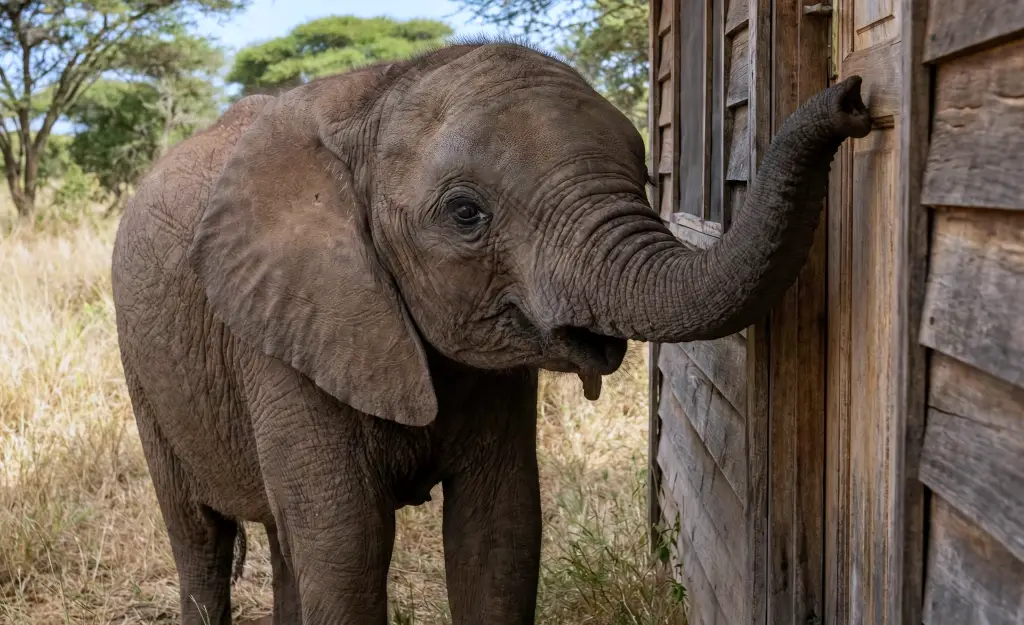
Taking a deep breath, he unlatched the heavy wooden door and pulled it open, fully expecting to find a human visitor standing on his small, covered porch. Instead, he found himself staring into a pair of intelligent, amber-dark eyes that belonged to a creature far more magnificent than any human caller.
A baby elephant stood before him.
Based on its size and the sparse, coarse hair still visible across its wrinkled gray skin, it was no more than six months old. The young calf’s trunk, still unsteady in its movements as all baby elephants’ trunks were, hung slightly to one side. But it was the elephant’s behavior that immediately captured Bob’s attention and triggered every professional instinct he possessed.
The calf stood completely alone.
In Bob’s extensive experience with African elephants, this was not just unusual; it was virtually impossible. Baby elephants never wandered far from their mothers. The complex, extended family structure of elephant herds meant that multiple adults—aunts, sisters, the matriarch—would always be watching over the young ones.
For a calf this young to be separated from its family was either a sign of terrible tragedy or indicated behavior so abnormal that it defied everything Bob understood about elephant social structures.
The baby elephant looked up at him with eyes that seemed to hold a depth of intelligence far beyond its few months of existence. Then, as if to confirm that this encounter was no mere coincidence, the calf lifted its small trunk and gently touched Bob’s outstretched hand.
It turned and took several deliberate steps away from the research station. It stopped, looked back at Bob, and then returned to the door.
The veterinarian’s mind raced as he analyzed the calf’s movements. This was not the random wandering of a lost, confused young animal. The elephant was exhibiting purposeful behavior, almost as if it were trying to communicate something specific.
The way it approached and retreated, the sustained direct eye contact, the gentle trunk touch—these were all signs of intention. Bob had dedicated his career to understanding animal behavior. Every instinct he had developed over decades of practice was screaming that this baby elephant needed help, but not the kind of help he might initially assume.
From his preliminary observation, the calf appeared physically healthy. Its gait was steady, its eyes were clear and alert, and its skin showed no obvious signs of injury or distress. No, this elephant was trying to tell him something, and Bob Mitchell had learned long ago to listen when animals spoke, even when they used no words.
The morning air was crisp and carried the distinctive, earthy scents of the African savannah. He smelled dust, dried grass, and the subtle but unmistakable musk of the vast wildlife populations that called this ecosystem home.
Bob stepped fully outside, closing the door softly behind him, and knelt down to the elephant’s level. This was a technique he had mastered years ago when dealing with frightened or traumatized animals, making himself less intimidating by reducing his physical silhouette.
The baby elephant approached him again, this time with more confidence. It extended its trunk and gently touched Bob’s face, a behavior that elephant researchers had documented as a form of reassurance-seeking or greeting among family members. The soft, warm suction of the trunk tip against his weathered skin sent a shiver through Bob that had nothing to do with the cool morning air.
“What is it, little one?” Bob whispered, his voice barely audible above the gentle morning breeze rustling through the acacia trees surrounding his station. “What are you trying to tell me?”
The elephant seemed to understand that it finally had Bob’s full attention. It backed away from the research station, took several deliberate steps toward the dense tree line, and then stopped to look back at him. The message was undeniably clear: Follow me.
But Bob’s scientific training and years of wildlife experience made him hesitate. Following an elephant—even a baby one—into the African wilderness was not a decision to be made lightly.
While this calf posed no physical threat, its presence alone indicated that something was seriously wrong in the local ecosystem. Adult elephants could be nearby and extremely protective of their young. If this calf was indeed lost, there could be frantic adult elephants searching the area, and a human’s presence might be interpreted as a threat.
Additionally, Bob’s work at the research station was governed by strict protocols designed to minimize human interference with natural wildlife behaviors. His role was to observe, document, and provide medical intervention only when absolutely necessary. Following a baby elephant based on an apparent invitation could be seen as a serious breach of those protocols.
Yet, as he looked into the calf’s eyes, Bob saw something that transcended professional handbooks and standard operating procedures. He saw desperate urgency.
This was not a lost baby elephant randomly seeking human contact. This was an intelligent creature that had deliberately sought out the one human in this remote area who might be able to help with whatever crisis had driven it to take such unprecedented action.
The elephant waited patiently as Bob wrestled with his decision. It didn’t continue into the forest, nor did it return to the door to resume its knocking. It simply stood there, watching him with an expression that seemed to combine hope with an almost human understanding of the gravity of its situation.
Bob thought about his journey to this place, about the chain of events that had brought him from a comfortable veterinary practice in Colorado to this remote research station in Kenya. His divorce had been finalized three years ago, but the emotional wounds had taken longer to heal.











Comments are closed.