
And I was finally in a place where remembering was allowed. By spring, the rhythm of life in Holton had settled around me like a second skin. Each morning, I’d wake before the sun, help June make oatmeal, and sit with Grandpa as he slowly stirred his spoon.
Sometimes he would even tell a half-finished story about fishing with his brothers or the time he dropped his wedding ring in a loaf of bread and never told Grandma. June started calling us “the quiet trio.” We didn’t need much noise, just presence.
I enrolled in a part-time nursing assistant course at the local community college, not because I planned it, but because something in me had shifted like a compass finally pointing north. Caring for Grandpa no longer felt like a sacrifice. It felt like an inheritance.
One afternoon, June found me in the kitchen poring over homework about dementia patient care. She set down a plate of cornbread. “You know, I think you were always meant for this.”
I shook my head. “I’m not strong enough. I cry too easily. I get overwhelmed.”
She smiled. “And yet, here you are.”
When my clinical rotation began, I started visiting the local memory care unit. Most of the residents didn’t know who I was. But when I read aloud, their eyes softened.
When I brought Grandpa’s old radio and played his favorite jazz station, some of them tapped their fingers to the beat. One woman, Margie, thought I was her daughter every time I walked in. I never corrected her.
I just sat and listened as she told the same story about her wedding day in 1952. Each retelling felt like a thread from a tapestry she was afraid would unravel. It made me think of Grandpa.
Even as his memory faded, he still felt. He still reached for my hand, still flinched at loud noises, still smiled at birdsong. And maybe that is the part no one teaches you in textbooks—that memory isn’t always in facts, it’s in feeling.
One day, as I wheeled Grandpa into the backyard, he turned to me, unexpectedly lucid. “You’re doing good, Laney. Real good.”
I knelt beside him. “I wish I could have done more.”
He shook his head slowly. “You did the one thing that mattered. You stayed.”
That night, I printed the photo we took together at the bus station—him smiling, bundled in my scarf, eyes closed in the sun. I placed it beside my bed. Not because he would remember.
But because I would. Because this chapter of my life, born from pain and defiance, had become something bigger. Not an escape. A homecoming.
The morning Grandpa passed, the house was silent. I found him in his chair by the window, hands resting on a worn blanket, the radio playing soft jazz in the background. His framed photo of Grandma was still on the table beside him.
His eyes were closed, his face peaceful, like he’d just dozed off mid-story. I didn’t cry at first. I just sat beside him, held his hand, and whispered.
“You can rest now. I’ll remember the rest for you.”
We buried him under the oak tree behind June’s house—his favorite spot. The ceremony was small, just June, a few neighbors, and me. I didn’t invite my parents, not out of anger.
But out of clarity. They hadn’t been part of his final chapter. They didn’t earn a place in its closing.
But a week later, I went back to Omaha. I needed to return not for them, but for me. I rang the doorbell of the house I grew up in.
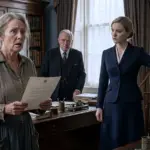
It looked smaller somehow, like a stage after the curtains close. Mom opened the door, her eyes wide. “Elena.”
She looked like she hadn’t slept in days. Dad stood behind her, arms crossed, but not defiant, just tired. “I heard about your grandfather,” she said softly.
I nodded. “He passed peacefully, with people who loved him.”
She looked down, hands wringing together. “We didn’t mean to…”
“You did,” I interrupted gently. “You meant to leave him at the airport, and you would have done the same to me if I hadn’t followed your script.”
Dad stepped forward. “He didn’t remember you most days. It wasn’t personal.”
“It was never about what he remembered. It was about what I wouldn’t forget.”
I reached into my bag and pulled out the envelope June had handed me the day before. Grandpa’s revised will. A quiet letter tucked inside.
His life savings, his pension, and a note: “You were the only one who stayed. My love belongs with you. Keep remembering. Grandpa.”
I handed it to them without a word. Their expressions shifted—shock, then guilt, then something more complicated. “I’m not here to fight. Just to let you know that I’m okay, and that he was too.”
I turned to leave, but Mom grabbed my wrist. “Elena, will you come home?”
I looked her in the eyes, really looked, and for the first time, I saw not cruelty but emptiness—a woman who’d built a life around control and now stood in its hollow center.
“I am home,” I said clearly. “In Holton. With the people who remembered me before I had to earn it.”
Back in Kansas, I returned to my studies, my patients, and the porch where Grandpa once sat. I opened a reading circle for children and seniors. I kept the photo of him and me on the wall beside my nursing certificate.
And every night, I whispered to the stars. “I didn’t let go.”
Because in choosing him, I chose myself. And that will always be enough.



Comments are closed.