
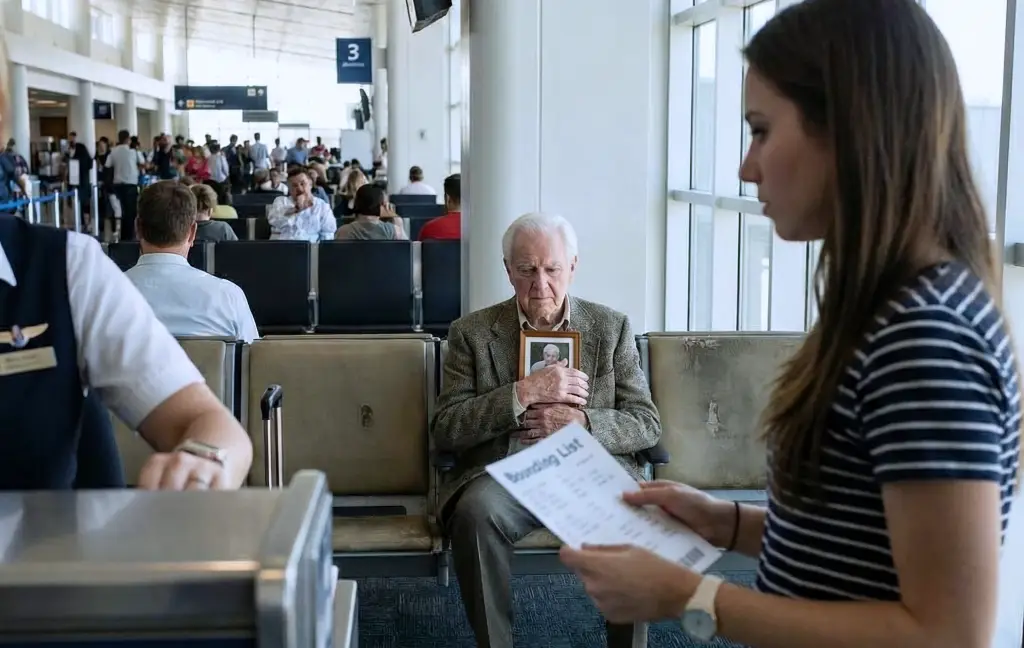
I never imagined that a quiet, sterilized airport lounge would be the setting where my entire understanding of family shattered. My name is Elena Foster, and for the vast majority of my existence, I played the role of the perfect daughter—obedient, composed, and largely invisible. But on that specific day, while we were ostensibly en route to South Africa for a grand family holiday, the script changed forever.
I watched my father lean down, pat my grandfather’s frail shoulder with a touch that felt more like a dismissal than a comfort, and deliver a sentence that would haunt me. The air in the terminal was frigid, smelling of floor wax and recycled air, a stark contrast to the burning pit forming in my stomach.
“Just sit right here, Dad,” he said, his voice smooth and practiced. “We are going to go check in, and we will be right back.”
They walked away. They were calm. They were certain, moving with the confident stride of people who never question their own righteousness. However, something about the situation did not sit right in my gut.
I watched them disappear into the crowd, and a strange silence seemed to settle around the row of seats where Grandpa sat. Minutes ticked by. I checked my watch. Then twenty minutes passed, each second stretching longer than the last.
Then, thirty minutes evaporated into the stale air of the terminal. That was the moment the realization hit me like a physical blow to the chest. They were not coming back.
My grandfather, confused, frail, and already drifting into the dense fog of Alzheimer’s, was being abandoned right there in the middle of a bustling terminal. He was being left behind like a piece of unclaimed luggage that had become too heavy to carry. I didn’t take a moment to think or weigh the consequences. I just ran.
What I witnessed when I finally found him changed everything I thought I understood about love, loyalty, and the true definition of home. To understand why, you have to understand where I came from. Growing up in Omaha, Nebraska, my life appeared distinctively perfect from the outside looking in.
We lived in a massive two-story house with pristine white shutters that looked like they were scrubbed daily. The lawn was always freshly cut, smelling of manicured success and chemical fertilizer. My father, Dr. Leonard Foster, was a widely respected cardiologist who preferred his dress shirts crisp and his children quieter than the heart monitors in his hospital wing.
My mother, Patricia, remained at home, though her role was not to nurture; it was to curate. She hosted fundraisers, baked immaculately decorated cookies for school galas, and constantly reminded us that presentation was everything. I was their firstborn, the responsible one, the project.
I was the straight-A student with perfectly combed hair and piano competition ribbons hanging above her bed like medals of war. Every family photograph displayed us smiling broad, vacant smiles that didn’t reach our eyes. Yet, no one ever noticed how I always folded my hands too tightly together, as if I were constantly bracing for an impact.
In our house, love was never spoken aloud. It was measured in grades, calculated in social standing, and weighed in silence. It was determined by how well you played along with the charade.
But Grandpa William? He was entirely different. He was the chaotic splash of color in our beige world. He was the only person who ever told me that I didn’t need to do anything to be worthy.
“You don’t need to earn love, Elena,” he would say, his voice raspy from years of teaching shop class. “Just be.”
Every Sunday when I was a small child, he would take me to the park while my parents attended their exclusive social club. We would feed the ducks and read books beneath the sprawling elm tree by the edge of the lake. He called me Laney, a nickname that no one else was permitted to use, a secret code between us.
I can still vividly remember his hands—scarred from years of working with wood and machinery—but they were always steady when he turned the pages of The Wind in the Willows for me. As I grew older, however, the visits became fewer and farther between. Dad claimed that Grandpa was getting slower and confusing the children.
Eventually, those precious Sundays stopped altogether. He was moved into the guest room upstairs, the one at the end of the hall. He was out of sight. He was out of the way.
But I would sneak up there sometimes, especially during my high school finals, when the crushing pressure of perfection made me feel as though I were suffocating. Grandpa never asked about my grades, my SAT scores, or my piano recitals. He just smiled, his eyes crinkling at the corners in a way that made me feel safe.
“Tell me something beautiful you saw today,” he would ask.
I always had an answer for him. A red bird. A funny cloud. He remembered the small things, even when he began to forget the bigger ones. At first, the slipping was harmless, almost charming.
He might call me Laney three times in a row, acting as if he was surprised I was still standing there. Then he would get stuck in stories from the deep past, repeating the same line about the war or his first car as if it were brand new information. My dad grew visibly annoyed, often rolling his eyes.
My mom started speaking about him in the past tense, even while he was sitting right there in the room with us, eating his dinner. But to me, he was still Grandpa. He was still the man who taught me how to look up at the sky and see more than just the weather.
And that is why, when Dad announced we were all going on a trip together to make memories before his condition worsened, I desperately wanted to believe him. I wanted to believe it even when a voice inside me whispered a warning. No one makes memories by leaving someone behind.
Before the forgetting truly began, Grandpa was the one person who remembered everything that actually mattered. He remembered that I detested chocolate milk but absolutely loved strawberry. He remembered my favorite stories, the specific way I hummed when I was nervous, and the fact that my middle name, May, was chosen after his mother, not my mom’s.
He never forgot me. Even when Alzheimer’s began eroding his sense of time and place, he held on to the essence of who I was. Even when he mixed up names and dates, somehow, he still looked at me like I was his safe harbor in a stormy sea.






Comments are closed.